
Quick answer: For almost every resident of Uttar Pradesh, the Central Gazette (Gazette of India, Part IV) is the right choice: it is what a passport office, a central recruitment, a university outside UP, a bank and a foreign application will accept without argument, and it costs Rs 1,100 for an adult with publication in 25 to 45 days. The UP State Gazette, published through the Directorate of Printing and Stationery, serves state-facing purposes and is genuinely useful in a narrow set of cases. Publishing in both is almost always a waste of money, because everything the state notification does, the Central one already does.
Ask this question online and you get the same sentence everywhere: the Central Gazette is recommended for wider acceptance. That is true and it is useless, because you are not choosing between "wider" and "narrower", you are deciding what to file this week. The useful version of the answer starts from the other end: name the desk that will look at your notification, and the choice makes itself. This page does that with a table, then explains how each publication actually works for someone in Uttar Pradesh, and clears up a myth that circulates on forums and costs people weeks.
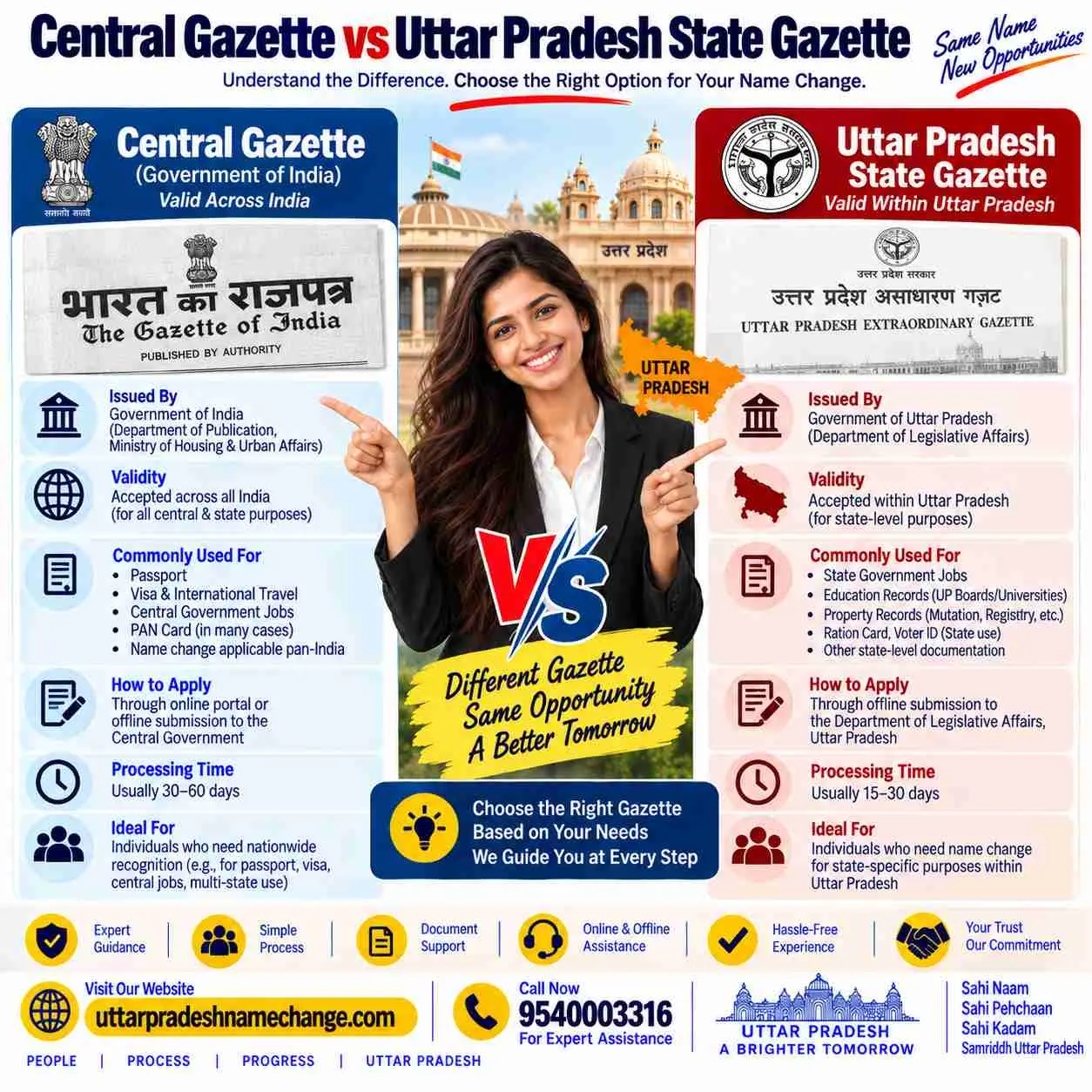
Central vs UP State Gazette at a Glance
| Central Gazette | Gazette of India, Part IV, published by the Department of Publication, New Delhi |
| UP State Gazette | Uttar Pradesh Rajpatra, printed through the Directorate of Printing and Stationery |
| Central acceptance | Nationwide and abroad: passport, central jobs, banks, universities, apostille |
| State acceptance | Strongest for state-facing records; questioned outside Uttar Pradesh |
| Central fee | Rs 1,100 adult, Rs 1,700 minor, on BharatKosh |
| Central timeline | 25 to 45 days from receipt at the Department |
| Where to check it | egazette.gov.in, searchable and free to download |
| Publishing in both | Rarely worth it: the Central notification already covers state purposes |
Key Takeaways
- Decide by destination, not by preference: if a passport, a central recruitment, a university outside UP or any foreign process is anywhere in your future, the Central Gazette is the only sensible choice.
- The Central Gazette absolutely does publish personal name changes; the forum claim that it does not is wrong, and Part IV exists precisely for these notifications.
- The UP State Gazette is a real publication with real uses, but its acceptance is strongest inside the state, and desks elsewhere ask questions the Central notification never invites.
- Publishing in both is almost always paying twice for one outcome, and the offices that suggest it should be asked which specific desk requires the second one.
- Whichever you choose, the preparatory work is identical, so the choice changes the destination of your file, not the effort of building it.
Gazette Routes: Quick Facts
| Central publisher | Department of Publication, Civil Lines, New Delhi |
| Central part | Part IV, which carries private individuals' notifications |
| Central payment | Online through bharatkosh.gov.in, never a demand draft |
| State publisher | Directorate of Printing and Stationery, Uttar Pradesh, dpsup.up.gov.in |
| State charges | Set by the Directorate, so confirm the current figure before filing |
| Preparation, either route | Affidavit, two newspaper advertisements, typed proforma, CD with signed printout |
| Proof afterwards | The downloaded PDF, kept in three printed copies for the counters |
| Validity | Permanent: a published notification does not expire |
Table of Contents
- The decision table
- What the Central Gazette actually is
- How the UP State Gazette works
- The myth that costs people weeks
- When publishing in both makes sense
- Cost and time, compared honestly
- Central Gazette name change: step by step
- Areas we serve
- Related guides
- Why choose our office
- FAQs
The Decision Table
| Where the notification will be used | Choose | Why |
|---|---|---|
| Passport application or reissue | Central | The strictest name-reading desk in the country, and the one most likely to question a state publication |
| Central government job, UPSC, SSC, banking, railways | Central | Central recruitment files are read against central records |
| Study or work outside Uttar Pradesh | Central | Another state's desk has no reason to be familiar with the UP Rajpatra |
| IIT, NIT or a central university record | Central | Institutional practice leans firmly this way |
| NRI, visa, apostille or any foreign process | Central | The Gazette of India is the recognisable national record abroad |
| Aadhaar, PAN, bank and insurance updates | Central | Accepted everywhere without a second question, which is the entire point |
| A purely state-facing record with no wider use | State is workable | Legitimate, but check first that nothing in your future needs the Central one |
Read the table backwards if it helps: the only row where the state publication is the sensible answer is the last one, and very few lives stay inside it. A twenty-four year old in Kanpur who does not need a passport today may need one in three years, and a second filing then costs more than getting it right now.
What the Central Gazette Actually Is
The Gazette of India is the Government of India's official journal of record, published by the Department of Publication in Civil Lines, New Delhi, and divided into parts by subject matter. Part IV carries notifications by private individuals, which is where a personal name change appears. Publication is electronic: once your file is processed, the notification appears on egazette.gov.in, searchable by name and free to download, and that PDF is the proof every counter afterwards will accept. Two practical features matter for Uttar Pradesh applicants. Nothing about it requires travel, since the file goes by courier and the result comes back as a download, and nothing about it depends on your district, so an applicant in Sonbhadra and one in Noida are on identical footing. The whole route is mapped on our gazette pillar.
How the UP State Gazette Works
The Uttar Pradesh Rajpatra is the state's own official journal, printed through the Directorate of Printing and Stationery at dpsup.up.gov.in, and it carries state notifications alongside the personal ones submitted to it. The preparatory work is the same as the Central route: a notarised affidavit, two newspaper advertisements, and a properly typed application. What differs is the destination of the file, the schedule on which the state press publishes, and the charges, which are set by the Directorate rather than by BharatKosh, so confirm the current figure before you commit rather than trusting a number on somebody's blog. Where the state route genuinely fits is a life that stays inside Uttar Pradesh's own systems. Where it starts to hurt is at the first counter outside them, and by then a second filing means repeating the affidavit and the advertisements too.
The Myth That Costs People Weeks
A claim circulates on forums, and gets repeated confidently, that the Central Government does not handle name changes, so a name change cannot appear in the Central Gazette at all. It is simply wrong. Part IV of the Gazette of India exists for notifications by private individuals, personal name changes among them, and files from Uttar Pradesh publish there every week, ours included. The confusion probably comes from the fact that no single Act commands you to publish a name change anywhere; the gazette is a practical requirement created by the institutions that ask for it, not a statutory one. That nuance is real and worth knowing, but it does not mean the Central Gazette is closed to you. Two smaller myths deserve the same treatment: you cannot pay by demand draft to any office in Lucknow, because payment is online, and no printed copy is posted to your address, because publication is electronic and you download it.
When Publishing in Both Makes Sense
Some offices suggest doing both "for safety", and it is worth being blunt: that is usually paying twice for one outcome, because a Central notification is accepted for state purposes as readily as for national ones. Ask any office recommending both to name the specific desk that will demand the second publication; if they cannot, the recommendation is revenue, not advice. The narrow situations where a second, state-level publication is sometimes discussed are internal state service matters where a department's own practice references the Rajpatra. Even there, the correct first step is to ask that department in writing what it requires, then file once. Our own position on client files is simple: we quote the Central route by default, and we do not sell a second publication unless a client shows us a written requirement for it.
Cost and Time, Compared Honestly
| Central government fee | Rs 1,100 adult, Rs 1,700 minor, Rs 250 for an alias line, paid on BharatKosh |
| Central publication time | 25 to 45 days after the Department receives the file |
| State charges | Set by the Directorate of Printing and Stationery; confirm the current figure directly |
| State timeline | Depends on the state press schedule rather than a published national window |
| Shared costs, either route | Affidavit Rs 100 to 500, two newspaper advertisements at a few hundred rupees each |
| Cost of choosing wrong | A second full filing: new affidavit, new advertisements, new fee |
The comparison that matters is not Rs 1,100 against whatever the state charges; it is one filing against two. Nearly every case we see where a client paid twice began with a state publication chosen for a small saving, followed by a passport or a job application eighteen months later. The full state-wide cost picture sits on our cost pillar.
Central Gazette Name Change: Step by Step
Our core service: once the table above has settled the choice, the Central route is a six-step file, and preparing it correctly the first time is what this office does every week. Note that steps one to three are identical whichever gazette you choose, so the decision costs you nothing in effort.
Swear the affidavit
Notarised on stamp paper with the old name, the new name, your address and the reason, Rs 100 to 500 at any notary in your district. Its exact wording becomes the master copy for everything that follows.
Publish two newspaper advertisements
One Hindi daily of your district (Dainik Jagran, Amar Ujala or Hindustan) and one English paper, both carrying old name, new name and address. Keep complete original pages, not clippings.
Prepare the proforma and CD
The typed "I hitherto known as" declaration signed by you and two witnesses with their details, plus the CD in the prescribed format and its signed printout. Handwritten proformas and unsigned CDs lead the rejection list.
Pay Rs 1,100 on BharatKosh
Online at bharatkosh.gov.in with the e-receipt saved, Rs 1,700 for a minor through a guardian. This is the step where the two routes finally diverge, because the state route pays the Directorate instead.
Courier the file to the Department of Publication
Civil Lines, New Delhi, with photo ID, address proof and photographs. From Lucknow this is a one to two day transit, and no personal visit is required from anywhere in Uttar Pradesh.
Download from Part IV and update
Publication in 25 to 45 days, free download from egazette.gov.in, then Aadhaar, PAN, bank, passport and the certificate family in that order, each citing the notification.
Gazette Fees, Time and the File
| Adult gazette fee | Rs 1,100 on BharatKosh |
| Minor, through a guardian | Rs 1,700 |
| Alias line, if wanted | Rs 250 extra |
| Affidavit at the notary | Rs 100 to 500 |
| Newspaper advertisements | A few hundred rupees per paper, edition-dependent |
| Publication time | 25 to 45 days after the Department receives the file |
| Our service | Basic from Rs 999, Complete from Rs 1,999, quoted separately |
The Department's checklist in one line: affidavit (notarised), newspapers (both, original, whole pages), proforma (typed, applicant plus two witnesses), CD with signed printout, photo ID, address proof, photographs, BharatKosh receipt.
Before You Apply: Check These
- Answer the destination question honestly, including the passport you might need in three years, because that is what decides the route.
- If an office recommends publishing in both, ask which specific desk requires the second one and expect the recommendation to change.
- Confirm any state-route charge with the Directorate directly rather than from a blog, and never prepare a demand draft for the Central route.
- Keep the wording identical across affidavit, both advertisements and the proforma, use a photograph under six months old, and sign the CD printout.
After the Gazette: What Updates Next
The order is the same whichever route you took, and it starts with Aadhaar because everything downstream copies it: Seva Kendra first, then PAN, then bank and passport, then the Tehsil certificate family, education records, licence, voter ID and property records. Keep three printed copies of the notification, because counters keep one and hand nothing back, and store the affidavit and both newspaper pages with them, since a passport file will ask for the newspapers again.
What Other Websites Get Wrong
- Wrong: the Central Gazette does not publish personal name changes. Right: Part IV exists for exactly this, and files from UP publish there every week.
- Wrong: publish in both for safety. Right: a Central notification already serves state purposes; ask which desk needs the second one before paying twice.
- Wrong: the state gazette is always cheaper overall. Right: the real comparison is one filing against two, and the second one repeats the affidavit and advertisements too.
- Wrong: pay by demand draft to a publications office. Right: the Central fee is paid online through BharatKosh, with the receipt in your name.
- Wrong: a printed gazette copy arrives by post. Right: publication is electronic and the PDF downloads free from egazette.gov.in.
Areas We Serve in Uttar Pradesh
This choice does not vary by district: a file from Bahraich and one from Noida face the same two options and the same decision table. We work with clients in all 75 districts, and these are the ones we file from most often:
| Purvanchal and eastern UP | Varanasi, Prayagraj, Gorakhpur, Azamgarh, Jaunpur, Ballia, Deoria, Mirzapur, Basti, Ghazipur, Mau, Sonbhadra |
| Western UP and NCR | Noida, Greater Noida, Ghaziabad, Meerut, Agra, Aligarh, Mathura, Bulandshahr, Muzaffarnagar, Saharanpur, Hapur, Firozabad |
| Rohilkhand and Bundelkhand | Bareilly, Moradabad, Rampur, Shahjahanpur, Budaun, Pilibhit, Bijnor, Amroha, Jhansi, Banda, Mahoba, Chitrakoot |
| Awadh and central UP | Lucknow, Kanpur, Unnao, Raebareli, Sitapur, Hardoi, Barabanki, Lakhimpur Kheri, Sultanpur, Ayodhya, Amethi, Bahraich |
What your district does change is the newspaper edition your advertisement runs in and the courier's transit time to Delhi. Our chamber is at Chamber No. 19, Sadar Tehsil, Sector 5, Gomti Nagar Vistar, Lucknow 226010, and the city guide sits on our Lucknow page. Call 9540003316 or WhatsApp 9540005002 from any district.
Related Guides on This Site
Every guide here is part of one connected map, so whichever counter your case lands at next, the page for it already exists:
- the gazette name change pillar: the full route, rejection causes, tracking and download.
- the name change process: affidavit, newspapers and gazette in order.
- the affidavit guide: wording, stamp value and the one-and-the-same variant.
- the newspaper advertisement guide: which papers, what wording, what to keep.
- the full cost breakdown: government fees and service fees, line by line.
- passport name change: the desk that most often decides this question for you.
- name change in Lucknow: notaries, newspapers and why no gazette office exists here.
- name spelling corrections: when you need no gazette at all.
- all our services: every name change service we handle.
- about our office: Vipin Chauhan and five years of Department filings.
- contact the office: Lucknow office, phone and WhatsApp.
- what is genuinely online: which steps happen on a screen and which are postal.
- the UP State Gazette process: the Directorate, the state presses and the two-question fit test.
- documents for the gazette file: the eight items and what each one prevents.
- the gazette office address: Civil Lines Delhi and how to courier from any district.
- the proforma format: the specimen, witness block and CD version.
- the BharatKosh payment guide: the exact path, codes and receipt rule.
- checking publication: the Part IV search and why no tracker exists.
- documents after marriage: the core set and what each counter keeps.
Why This Question Is Worth Asking Us First
This is the cheapest question in the whole process to get right and one of the most expensive to get wrong, because the cost of a wrong choice is not a fee, it is a second complete filing. Vipin Chauhan, B.Tech LL.B, has spent five years filing with the Department of Publication from Lucknow.
- We ask about your next five years, not just today: a passport, a central job application or a move outside UP decides this, and those plans are what the first call is about.
- We do not sell double publication: unless you show us a written requirement for a second notification, we will file once and say so plainly.
- We quote the state route honestly: where it genuinely fits, we say so, and we send you to confirm the Directorate's current charge rather than inventing one.
- The Central file is our daily work: wording, both newspaper pages, typed proforma, signed CD, correct fee head, courier and tracking to Part IV.
Associate office at Chamber No. 19, Sadar Tehsil, Gomti Nagar Vistar, Lucknow, serving all 75 districts of Uttar Pradesh, Monday to Saturday, 10 AM to 6:30 PM. Call 9540003316 or WhatsApp 9540005002.
One Decision, Then One Filing
Uttar Pradesh Name Change
Associate Office: Chamber No. 19, Sadar Tehsil, Sector 5, Gomti Nagar Vistar, Lucknow, Uttar Pradesh 226010
Head Office: Metro Pillar 337, Hardev Nagar, Street 1, Shop No 1 (Shri Sham Documentation)
Call: 9540003316
WhatsApp: 9540005002
Email: info@uttarpradeshnamechange.com
Hours: Mon to Sat, 10 AM to 6:30 PM
Tell us where the notification will be used, passport, job, university, bank or a state record, and we will name the right gazette before you spend a rupee.
Get Call and Name Change Format
Loading the enquiry form...
Central vs UP State Gazette: FAQs
Which gazette should I choose for a name change in Uttar Pradesh?
The Central Gazette, in almost every case. It is accepted by passport offices, central recruitments, banks, universities and foreign processes without question, at Rs 1,100 for an adult with publication in 25 to 45 days. The UP State Gazette suits a narrow set of purely state-facing purposes.
Is it true that the Central Gazette does not publish name changes?
No, that claim is wrong. Part IV of the Gazette of India carries notifications by private individuals, and personal name changes from Uttar Pradesh publish there every week. What is true is that no single Act commands publication at all; the gazette is a practical requirement created by the institutions that ask for it.
Is a UP State Gazette notification valid outside Uttar Pradesh?
It is a genuine official publication, but its acceptance is strongest inside the state, and desks elsewhere are entitled to ask questions that a Central notification never invites. If anything in your future sits outside UP's own systems, choose Central.
Should I publish in both to be safe?
Almost never. A Central notification is accepted for state purposes as readily as national ones, so a second publication usually means paying twice for one outcome. Ask any office recommending both to name the desk that requires the second one.
What does each route cost?
The Central fee is Rs 1,100 for an adult and Rs 1,700 for a minor, paid on BharatKosh. State charges are set by the Directorate of Printing and Stationery, so confirm the current figure directly rather than from a blog. The affidavit and both newspaper advertisements cost the same either way.
Which gazette does the passport office want?
In practice, the Central one. The passport office is the strictest reader of names in the country and the desk most likely to question a state publication, which is why anyone who may ever apply for or reissue a passport should file Central from the start.
How do I check that my notification has published?
Search your name on egazette.gov.in under Part IV for the relevant date range and download the PDF free. Keep three printed copies, because counters keep one and hand nothing back.
Does a gazette notification expire?
No. Once published it is permanent, and old certificates in the previous name continue to be explained by it for the rest of your life, which is why the copy belongs in your permanent file.
Can I pay the Central fee by demand draft in Lucknow?
No. Payment is online through bharatkosh.gov.in with the e-receipt in your name. Any advice about a demand draft favouring a publications office is outdated and will cost you a wasted trip.
Is the preparation different for the two routes?
No. Affidavit, two newspaper advertisements and a typed application are common to both, so the choice changes where the file goes and what you pay, not the effort of building it.
I already published in the state gazette and now need the Central one. What now?
The Central filing is made afresh: a new affidavit, new advertisements and the Rs 1,100 fee. That repetition is exactly why the destination question deserves an honest answer at the start.
Where is the UP State Gazette published from?
Through the Directorate of Printing and Stationery, Uttar Pradesh, at dpsup.up.gov.in, which handles the state's official printing. Confirm current charges and the submission process with the Directorate before committing to that route.
Official Sources
- The Department of Publication, Civil Lines, New Delhi, which publishes Part IV of the Gazette of India, where private individuals' name change notifications appear.
- The Directorate of Printing and Stationery, Uttar Pradesh, dpsup.up.gov.in, for the state's official printing and the UP Rajpatra.
- egazette.gov.in for searching and downloading published notifications free.
- bharatkosh.gov.in, the payment route for the Central fee of Rs 1,100.
Facts on this page are checked against these sources and our own filing experience. State charges and schedules change; the destination rule, the Part IV position and the Central fee are the stable core.
The Short Version
Decide by destination. A passport, a central recruitment, a university outside UP, an NRI or apostille process, or simply the wish never to be asked twice, all point to the Central Gazette: Part IV of the Gazette of India, Rs 1,100 for an adult, published in 25 to 45 days and downloaded free from egazette.gov.in. The UP State Gazette, printed through the Directorate of Printing and Stationery, fits a narrow band of purely state-facing purposes. Publishing in both is usually paying twice for one outcome. And the forum claim that the Central Gazette does not handle name changes is simply false. WhatsApp 9540005002 and tell us where the notification will be used; we will name the right route before you spend anything.