
Quick answer: The sentence every spelling affidavit turns on is that both versions are "the name of one and the same person, that is, myself". Around it, four drafts cover the situations we actually see: the one-and-the-same-person affidavit for banks and employers, the correction request version for an authority being asked to amend a record, the parent's name version where the difference is in a father's or mother's name, and the board and university version that names the examination and roll number. All are notarised on stamp paper, usually Rs 100 to 500 all in, and all should be short, because an affidavit that explains too much invites questions.
Downloaded templates fail for a predictable reason: they are written for one destination and used at another. A bank wants to know that two names are one person. A board wants to know which examination record you are talking about. An authority being asked to amend something wants the request itself, not just a declaration. The wording differs in each case, and the difference is small but it is the difference between a document that settles a matter and one that gets handed back. Our affidavit pillar covers stamp paper, notaries and execution; this page is about the words.
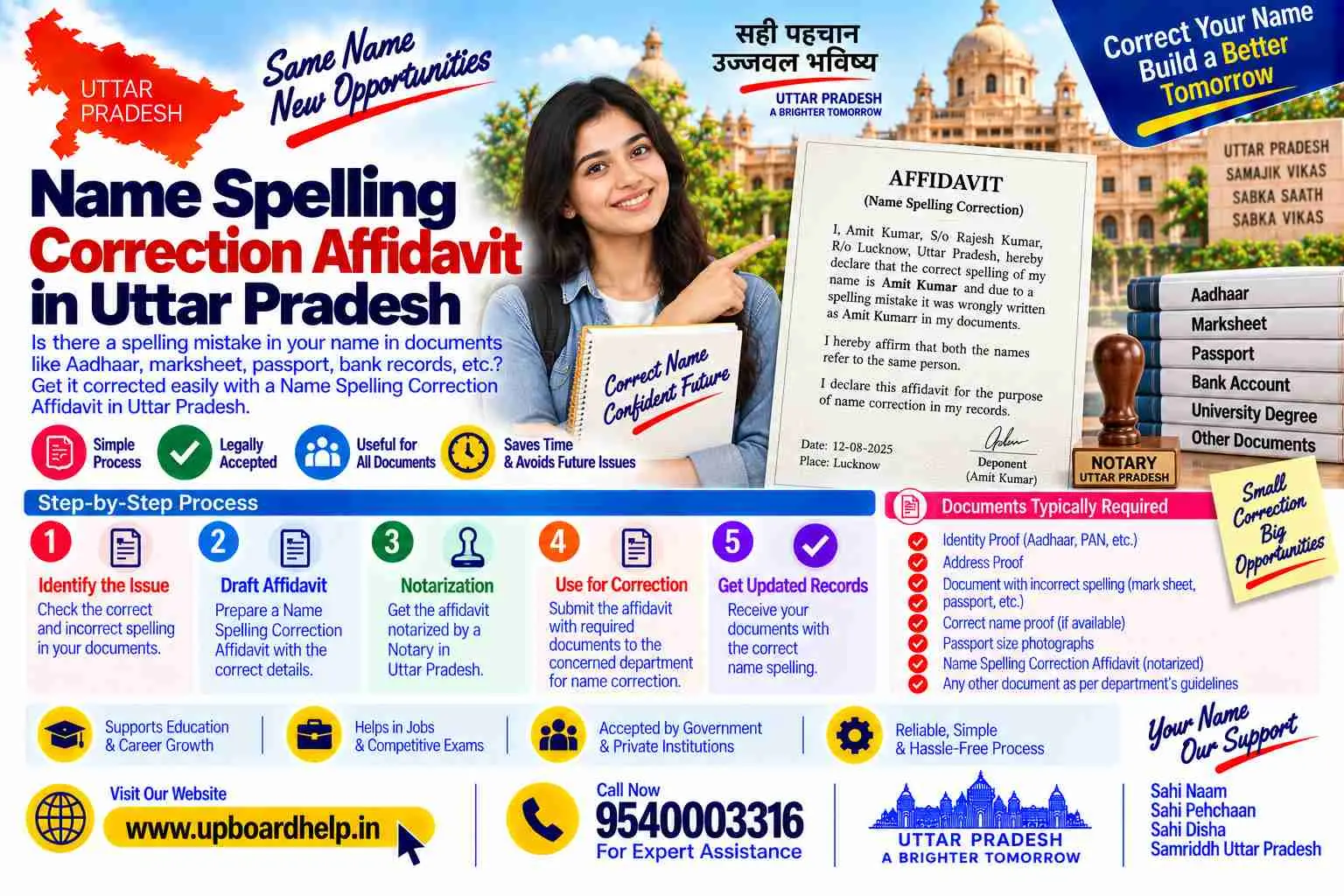
The Four Drafts at a Glance
| One and the same person | Banks, employers, insurers; to live with the difference |
| Correction request | Any authority being asked to amend its record |
| Parent's name version | Where a father's or mother's name differs across documents |
| Board and university version | Names the examination, roll number and year |
| The clause they share | Both names refer to one and the same person, namely the deponent |
| Stamp paper | Non-judicial; value varies, so ask the notary drafting it |
| Typical cost | Rs 100 to 500 including stamp paper and notary |
| Signing | In the notary's physical presence, never beforehand |
Key Takeaways
- The one-and-the-same-person clause is what every spelling affidavit exists to say, and the rest of the document is context around it.
- Match the draft to the destination, because a declaration and a correction request are different documents even when the facts are identical.
- Keep it short: every extra sentence is another statement someone can question, and none of them help.
- Quote document numbers rather than describing documents, since a reader wants to match your affidavit against papers in front of them.
- An affidavit lets you live with a difference; it does not amend anything, so where a record must actually change, it accompanies an application rather than replacing one.
Drafting Rules: Quick Facts
| Name both versions exactly | Letter for letter, as printed on each document |
| Identify each document | By number, date and issuing authority |
| State the relationship | Son, daughter or wife of, matching your identity documents |
| Give the reason once | A clerical or transliteration difference, in one line |
| Do not admit fault | Neither yours nor the authority's; state the fact only |
| Do not narrate history | How it happened is not what anyone is deciding |
| Sign in the old or new name? | Sign as you sign now; note both names in the body |
| Witnesses | Not usually required, unlike the gazette proforma |
Table of Contents
- The clause that does the work
- Draft one: one and the same person
- Draft two: correction request
- Draft three: parent's name
- Draft four: board and university
- What to leave out, and why
- Central Gazette name change: step by step
- Areas we serve
- Related guides
- Why choose our office
- FAQs
The Clause That Does the Work
Everything else in a spelling affidavit is scaffolding for that sentence. It works because it closes the only question the reader actually has: whether they are looking at one person or two. Two details in it are worth keeping rather than trimming. The phrase "that is, myself" ties the statement to the deponent explicitly, which matters when an affidavit is read alongside a father's or a spouse's documents. And the closing clause about no other person of either name forecloses the alternative reading, which is exactly what a cautious clerk is worried about.
Notice what the clause does not do: it does not amend anything. It lets an institution accept two versions as one person, which is enough where nothing needs changing, and it accompanies an application where a record does. That distinction is the subject of our correction versus change page.
Draft One: One and the Same Person
For banks, employers, insurers and ordinary institutional paperwork, where you are asking the reader to accept both versions rather than to change anything.
Clause three is the one people omit and it is worth including, because it tells the reader what kind of situation this is before they have to work it out. Where the difference is a Hindi to English rendering, say transliteration specifically, and consider attaching the Devanagari record as our transliteration page explains.
Draft Two: Correction Request
Where an authority is being asked to amend its own record, the affidavit needs to do one extra thing: identify which document is the outlier and what you want done.
Two deliberate choices here. Clause one establishes the correct name against documents you already hold, which is what makes this a correction rather than a change. And clause five states the purpose, which keeps the affidavit tied to one application instead of floating as a general declaration, something authorities prefer.
Draft Three: Parent's Name
Where the difference is in your father's or mother's name rather than your own, and it appears differently across your documents.
The critical difference from draft one: the one-and-the-same clause names your parent, not you, and a separate clause establishes your relationship to them. Affidavits that get this wrong read as if the deponent is claiming to be their own father, which sounds absurd until you see how often a template gets adapted carelessly. Where the parent is available, some desks prefer the affidavit sworn by the parent themselves, which is worth asking before drafting. Our father's name page covers the wider case.
Draft Four: Board and University
For a school board, college or university, where the reader needs to locate you in a record rather than merely believe you.
Clause one is the reason this draft exists. A board or university does not begin by assessing your claim; it begins by finding you in a register, and the examination, year, roll number and registration number are what make that possible. An affidavit without them is a slower affidavit even when everything else is perfect, as our UP Board correction guide explains.
What to Leave Out, and Why
- How the error happened. Whether a clerk mistyped it or your father filled the form in a hurry is not what anyone is deciding, and speculating about it invites doubt about your knowledge of your own records.
- Blame, in either direction. Do not say the school was careless and do not say you were. State the fact of the difference and stop.
- Every document you own. Name the two or three that matter. A list of eleven documents reads as anxiety rather than thoroughness.
- Promises about the future. Undertakings to use only one name from now on belong in a gazette declaration, not in a spelling affidavit.
- Anything you are not certain of. An affidavit is a sworn statement, so a detail you half-remember about a 2003 record should simply not appear.
- Emotional framing. Difficulty faced, harassment suffered, urgency of the matter. None of it changes the decision and all of it lengthens the document.
The underlying principle is worth stating plainly: an affidavit is read for what it asserts, and every assertion is something that can be questioned. A four-clause affidavit stating only verifiable facts is stronger than a twelve-clause one that explains, apologises and pleads. Short is not lazy here; short is careful.
Central Gazette Name Change: Step by Step
Our core service: a spelling case usually needs only the affidavits above. Where a genuine name change is involved, the gazette route applies, and this is the filing our office runs from Lucknow every week.
Swear the affidavit
The gazette version, which differs from all four drafts above, carrying the old name, the new name, your address and the reason.
Publish two newspaper advertisements
One Hindi daily of your district (Dainik Jagran, Amar Ujala or Hindustan) and one English paper, complete original pages kept flat.
Type the proforma and prepare the CD
Two typed copies with two witnesses giving their signature, full name and address, and the CD carrying the declaration as typed Word text.
Pay Rs 1,100 on BharatKosh
Before dispatch, with the printed receipt going into the envelope as an enclosure.
Courier the file to Civil Lines
Tracked dispatch to the Department of Publication, Delhi 110054, with your phone and email on the covering letter.
Download and run the counters
Publication in 25 to 45 days, free download, then Aadhaar, PAN, bank and the rest in order.
The Fifth Affidavit, and How It Differs
The gazette affidavit is not a variant of the four above; it does the opposite job, and confusing them is why files come back.
A practical saving for anyone who needs both, which happens when a marksheet correction runs alongside a genuine change: have them drafted together and sworn at one notary sitting. One trip, one stamp paper purchase, and the wording stays consistent between them, which matters when a counter later reads both. The gazette specimen is on our proforma guide.
Gazette Fees, Time and the File
| Spelling affidavit | Rs 100 to 500 including stamp paper and notary |
| Aadhaar update | A nominal fee at a Seva Kendra |
| Board correction | Around Rs 1,000 per application |
| Adult gazette fee | Rs 1,100 on BharatKosh, only where a genuine change is involved |
| Newspaper advertisements | A few hundred rupees per paper, edition-dependent |
| Publication window | 25 to 45 days after the Department receives the file |
| Our service | Basic from Rs 999, Complete from Rs 1,999, quoted separately |
The Department's checklist in one line: covering letter with phone and email, affidavit (notarised), newspapers (both, original, whole pages), proforma (typed, two copies, applicant plus two witnesses), CD with signed declaration, photo ID, address proof, photographs, BharatKosh receipt.
Before You Apply: Check These
- Pick the draft that matches your destination rather than downloading a general template.
- Fill both spellings letter for letter as they appear on the documents, not as you remember them.
- Quote document numbers, and for a board add the examination, year, roll number and registration number.
- Sign only in the notary's presence, and read the whole page once before signing.
After the Gazette: What Updates Next
For a pure spelling case there is nothing to publish, so the affidavit goes with your correction application to whichever authority holds the outlier record, and then the standard order follows: Aadhaar, PAN, bank and the rest. Keep the affidavit filed with both documents permanently, because the same question tends to be asked again years later by a different desk.
What Other Websites Get Wrong
- Wrong: one affidavit template fits every spelling case. Right: a declaration and a correction request are different documents.
- Wrong: a longer affidavit is a stronger one. Right: every extra assertion is something that can be questioned.
- Wrong: explain how the mistake happened. Right: nobody is deciding that, and speculation weakens the document.
- Wrong: the same wording works for a parent's name. Right: the one-and-the-same clause must name the parent, with your relationship stated separately.
- Wrong: an affidavit changes the record. Right: it lets an institution accept two versions, or supports an application that does the changing.
Areas We Serve in Uttar Pradesh
Notaries sit in every district court complex and tehsil in the state, so this is the one step that never requires travel. We draft and send the wording, you print it on stamp paper locally. We serve all 75 districts, most often these:
| Rohilkhand and Bundelkhand | Bareilly, Moradabad, Rampur, Shahjahanpur, Budaun, Pilibhit, Bijnor, Amroha, Jhansi, Banda, Mahoba, Chitrakoot |
| Awadh and central UP | Lucknow, Kanpur, Unnao, Raebareli, Sitapur, Hardoi, Barabanki, Lakhimpur Kheri, Sultanpur, Ayodhya, Amethi, Bahraich |
| Purvanchal and eastern UP | Varanasi, Prayagraj, Gorakhpur, Azamgarh, Jaunpur, Ballia, Deoria, Mirzapur, Basti, Ghazipur, Mau, Sonbhadra |
| Western UP and NCR | Noida, Greater Noida, Ghaziabad, Meerut, Agra, Aligarh, Mathura, Bulandshahr, Muzaffarnagar, Saharanpur, Hapur, Firozabad |
Stamp paper values and notary charges vary a little between districts, which is why the honest range is Rs 100 to 500 rather than a single figure. Our chamber is at Chamber No. 19, Sadar Tehsil, Sector 5, Gomti Nagar Vistar, Lucknow 226010, with the city guide on our Lucknow page. Call 9540003316 or WhatsApp 9540005002 from any district.
Related Guides on This Site
Every guide here is part of one connected map, so whichever counter your case lands at next, the page for it already exists:
- the affidavit pillar: stamp paper, notaries and execution.
- correction versus change: which route your case is on.
- transliteration mismatch: when to say transliteration in clause three.
- the spelling correction pillar: the router this page sits under.
- UP Board marksheet correction: where the board draft is used.
- father's name corrections: the wider case behind draft three.
- marksheet and Aadhaar mismatch: where an affidavit is enough and where it is not.
- the proforma format: the gazette declaration, which does the opposite job.
- Aadhaar name update: usually the first record to standardise.
- the full cost breakdown: government fees and service fees, line by line.
- contact the office: Lucknow office, phone and WhatsApp.
- two different names on your documents: three sub-cases, the alias option, and the full gazette route.
- does a correction need a gazette?: no, and the one question to ask.
- the two-update limit: two name updates for life and the exception route.
- Aadhaar spelling correction: why minor is not lighter, and the document that decides.
- Aadhaar mismatch with other records: machine matched or human read.
- father's name in a UP Board marksheet: the school route and whose proof is needed.
- father's name across your documents: mapping the split and the one-notice route.
- father's name in Aadhaar: the Care of field and its lighter rules.
- father's name affidavit formats: four drafts and who swears each.
- adding a name to a birth certificate: inclusion, for a blank name field.
- the Nagar Nigam route: for a city birth record.
- birth certificate spelling correction: proving the oldest record wrong.
- mother's name affidavit formats: four drafts with the bridge clause.
Why We Ask Where It Is Going First
The facts of a spelling case rarely change; the destination does, and that is what decides the draft. A bank affidavit handed to a board is not wrong, it is just slower, and a template adapted carelessly for a parent's name can be genuinely confusing. Vipin Chauhan, B.Tech LL.B, has drafted these for five years.
- We match the draft to the desk: declaration, correction request, parent's name or board version.
- We keep it short on purpose: four clauses of verifiable fact rather than twelve of explanation.
- We fill the identifiers properly: document numbers, and for boards the examination, year and roll number.
- We draft both at once where both are needed: spelling affidavit and gazette affidavit, at one notary sitting.
Associate office at Chamber No. 19, Sadar Tehsil, Gomti Nagar Vistar, Lucknow, serving all 75 districts of Uttar Pradesh, Monday to Saturday, 10 AM to 6:30 PM. Call 9540003316 or WhatsApp 9540005002.
Tell Us Where It Is Going
Uttar Pradesh Name Change
Associate Office: Chamber No. 19, Sadar Tehsil, Sector 5, Gomti Nagar Vistar, Lucknow, Uttar Pradesh 226010
Head Office: Metro Pillar 337, Hardev Nagar, Street 1, Shop No 1 (Shri Sham Documentation)
Call: 9540003316
WhatsApp: 9540005002
Email: info@uttarpradeshnamechange.com
Hours: Mon to Sat, 10 AM to 6:30 PM
Send both spellings exactly as printed, the document numbers, and where the affidavit is going. We will return the right draft ready for stamp paper.
Get Call and Name Change Format
Loading the enquiry form...
Spelling Correction Affidavit: FAQs
What is the key sentence in a spelling affidavit?
That both versions are the name of one and the same person, that is, yourself, with no other person of either name connected to the documents. Everything else is context around that sentence.
Can I use one affidavit everywhere?
Not well. A declaration for a bank and a correction request for an authority are different documents even when the facts are identical, and a board version needs your examination, year and roll number to locate you in a register.
Should I explain how the mistake happened?
No. Nobody is deciding that, and speculating about a form filled twenty years ago weakens rather than strengthens the affidavit. State the difference and stop.
What stamp paper value should I use?
There is no single national figure, so ask the notary drafting it in your district. The whole affidavit, stamp paper and notary included, usually costs Rs 100 to 500.
Do I need witnesses?
Not usually for an affidavit, unlike the gazette proforma which does require two witnesses with full details. Follow the receiving authority's own procedure if it asks for more.
My father's name is spelled differently. Whose affidavit is it?
Yours, but the one-and-the-same clause must name your father rather than you, with a separate clause establishing that you are his child. Some desks prefer the affidavit sworn by the parent, so ask before drafting.
Which name do I sign it in?
Sign as you sign now, and let the body of the affidavit record both versions. The signature identifies the deponent; the clauses do the explaining.
Does the affidavit change my record?
No. It lets an institution accept two versions as one person, which is enough where nothing needs amending. Where a record must actually change, the affidavit supports an application rather than replacing it.
How long should it be?
Four or five clauses. A short affidavit stating only verifiable facts is stronger than a long one that explains, apologises and pleads, because every extra assertion is something that can be questioned.
Can I sign it before going to the notary?
No. The signature must be made in the notary's physical presence, and an affidavit signed beforehand is not properly executed however neat it looks.
Do I need this if I am publishing a gazette?
Possibly both. The gazette affidavit says you shall hereafter be known by a new name; the spelling affidavit says two existing versions are one person. If you need both, have them drafted together and sworn at one notary sitting.
Will a portal accept my affidavit?
No. Automated matching cannot read an affidavit, so where a system compares names character by character, the record itself has to be corrected rather than explained.
Official Sources
- Affidavit formats published by Indian Missions and professional bodies, which use the one-and-the-same-person declaration in the same form.
- UIDAI's update framework and UPMSP correction services, which treat supporting affidavits as accompanying an application rather than replacing one.
- The Department of Publication's requirements for the gazette affidavit, which is a different document from the drafts on this page.
- Our own drafting experience across banks, boards, universities and employers in Uttar Pradesh.
Facts on this page are checked against these sources and our own casework. Receiving authorities occasionally prescribe their own wording, which always takes precedence; the one-and-the-same clause and the short-is-stronger principle are the stable core.
The Short Version
Every spelling affidavit turns on one sentence: that both versions are the name of one and the same person, that is, yourself, with no other person of either name connected to the documents. Four drafts cover the real situations: a declaration for banks and employers, a correction request for an authority being asked to amend a record, a parent's name version where the one-and-the-same clause names your father or mother rather than you, and a board version that adds the examination, year, roll number and registration number so the reader can find you in a register. Keep all of them short, quote document numbers rather than describing documents, and leave out how the error happened, who was at fault and any promise about the future. An affidavit lets you be accepted as you are; only an application changes a record.