
Quick answer: A mother's affidavit usually needs a clause a father's never does: the line stating that her maiden name and her married name belong to one woman. Without it, an office reading your file sees two names and no explanation. Which format you use depends on the situation: her name recorded wrongly, her name missing entirely, her own document being corrected, or a mother who has passed away. All four are below, each with the joining clause written in.
Copied templates fail here more often than anywhere else in this subject, and the reason is simple. Somebody downloads a father's affidavit, changes "father" to "mother", and hands it in. It reads correctly and proves nothing, because the actual question an office has is not "what is her name" but "why does your marksheet say one thing and her Aadhaar another". A father's affidavit never has to answer that. Yours does.
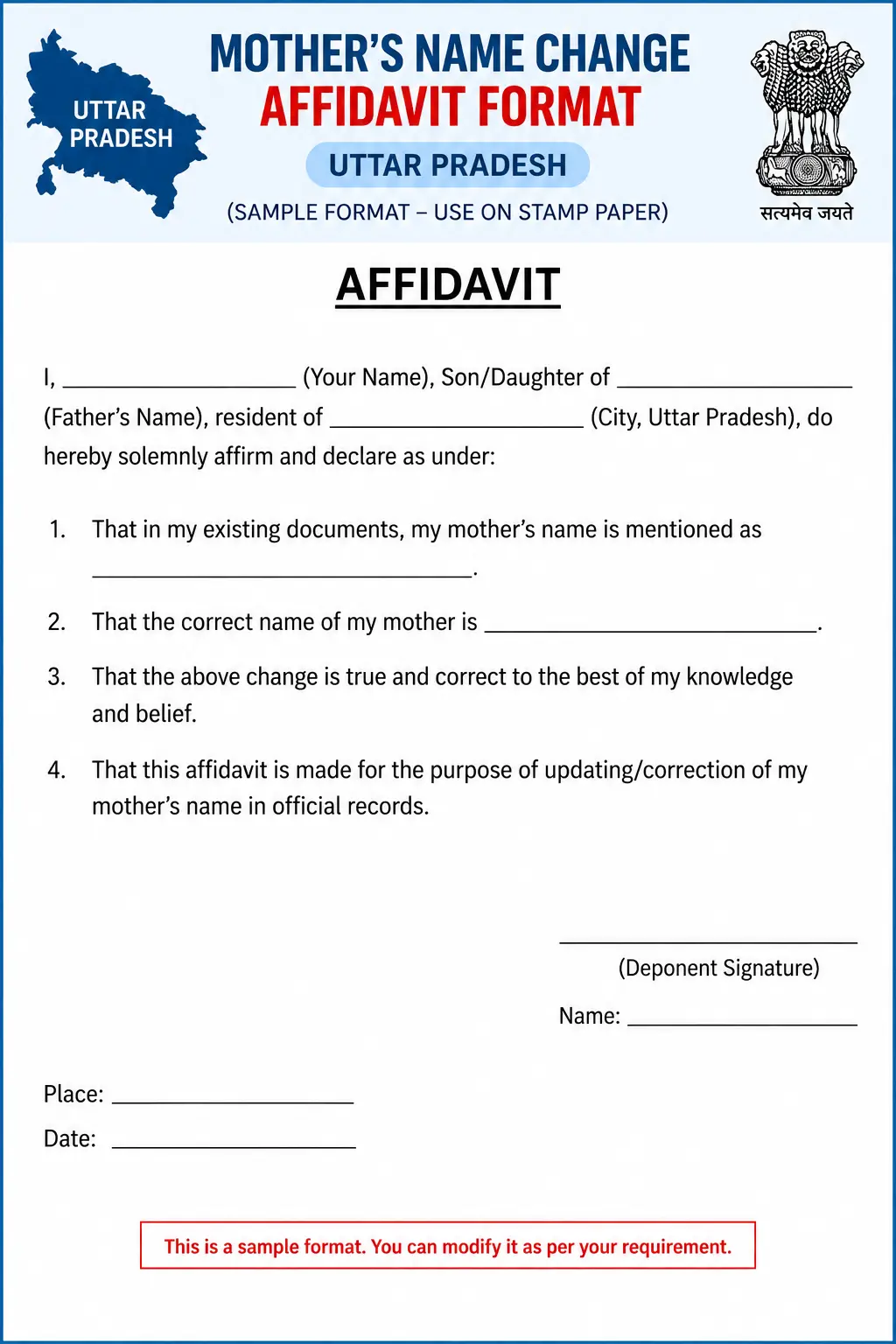
Choosing the Format at a Glance
| Her name wrong in your document | Format One: you swear it |
| Her name missing altogether | Format Two: an addition, not a correction |
| Her own document is wrong | Format Three: she swears it |
| She has passed away | Format Four: you swear it, with support |
| The clause they all share | Maiden and married names are one woman |
| Stamp paper | Non-judicial; value varies by district |
| Typical cost | Rs 100 to 500 with stamp paper and notary |
| Signing | In the notary's presence, never before |
Key Takeaways
- The bridge clause joining her two names is what makes a mother's affidavit work.
- A father's template with the word swapped leaves the real question unanswered.
- Who swears it depends on whose document is wrong, not whose name appears in it.
- Where the marriage was registered, name the certificate inside the affidavit itself.
- A missing name needs addition wording, which is a different document from a correction.
Drafting Rules: Quick Facts
| Name both versions exactly | Letter for letter as printed on each document |
| Say she is your mother | In its own clause, not implied |
| Join the two names | The bridge clause, in every mother's affidavit |
| Cite the marriage certificate | By number and date, where one exists |
| Identify each document | By name and number |
| Do not | Explain how the difference arose |
| Length | Four or five clauses is plenty |
| Witnesses | Not needed on an affidavit, unlike the gazette Public Notice |
Table of Contents
- The clause fathers never need
- Format one: her name wrong in your document
- Format two: her name missing
- Format three: she swears it herself
- Format four: she has passed away
- The mistakes we see most
- Central Gazette: the complete process and file format
- Areas we serve
- Related guides
- Why choose our office
- FAQs
The Clause Fathers Never Need
That second version answers the question an office is actually holding. It explains, in one sentence, why two of your documents disagree without either being wrong. Leave it out and the reader has to guess, and readers who guess tend to ask for more papers.
Where the marriage was registered, add the certificate by number and date in the same clause. That converts your statement into something the office can verify, which is always stronger than something it has to accept.
Format One: Her Name Wrong in Your Document
The common case. Her name is recorded incorrectly on your marksheet, birth certificate or another record of yours.
Clause two is the one this whole page exists for. Clause one, establishing that you are her child, is the one people leave out and then wonder why the reader hesitates.
Format Two: Her Name Missing
Where the record has no mother's name at all, because the old form had no such column. This is an addition, and the wording has to say so.
Notice what clause three does: it explains the blank instead of complaining about it. That matters, because an affidavit alleging an error where none exists puts the clerk in the position of disagreeing with you before they have read the request. The wider approach is on our missing name page.
Format Three: She Swears It Herself
Where her own document is the one being corrected, she is the deponent and the wording shifts.
The test for which format applies is whose document carries the problem, not whose name is in it. Her name on your marksheet is still your document and your application. Her name on her own PAN is hers. The full deponent test is set out on our parent affidavit page.
Format Four: She Has Passed Away
Use the word late throughout rather than once, so a reader is never in doubt. Clause four names the specific surviving record you are relying on, which turns a family recollection into a document comparison. Send the file complete, because nothing further can be produced afterwards.
The Mistakes We See Most
| Mistake | Why it matters |
|---|---|
| A father's template with the word swapped | Leaves out the bridge clause, so the two-name question stays unanswered |
| "that is, myself" instead of "namely my mother" | Reads as though you are claiming to be your own mother |
| No relationship clause | Nothing establishes your standing to speak about her |
| Correction wording for a missing name | Alleges an error that does not exist and starts the conversation badly |
| Explaining how the difference arose | Nobody is deciding that, and it adds statements that can be questioned |
The first is the expensive one, because the affidavit looks perfectly well drafted and still does not do its job. If you take one thing from this page, take the bridge clause.
Central Gazette: the Complete Process and File Format
Our core service: a mother's name correction almost never needs publication. Where the same wrong version runs through several of your documents, one correction notice covers them all, and this is the file exactly as the Department receives it.
Stage 1: The gazette affidavit
This one is deliberately shorter than the four above. The gazette version carries the substance and the verification and nothing else, and it names each document so the published notice is usable at every counter afterwards.
Stage 2: The Public Notice, in two copies
Each witness gives signature, full name and address, and both sign both copies at one sitting. Unlike the affidavits above, the Public Notice does need witnesses, which is a difference worth noticing.
Stage 3: The CD and CD-Certificate
Stage 4: Newspapers, fee, covering letter and dispatch
Publish in two newspapers
One Hindi daily of your district and one English paper, booked the day the affidavit is sworn, keeping complete original pages with masthead and date, and buying two copies of each.
Pay Rs 1,100 on BharatKosh
Before the envelope is sealed, with the function head, PAO and DDO checked on the confirmation screen and two receipts printed.
Write the covering letter
To The Controller, Publication Department, Civil Line, Delhi 110054, saying the formalities are complete and the documents are enclosed, with your mobile number and email.
Assemble, check and photocopy
Affidavit, Public Notice in two witnessed copies, CD with CD-Certificate, both newspaper pages, identity and address proof, photographs and the receipt, with a full copy set at home.
Courier it, tracked
One to three days from most UP districts, with no counter to visit.
Search Part IV after 25 to 45 days
Weekly Gazette, Part IV, a Saturday date range covering your window, then download the whole issue.
Draft Them Together, Swear Them Together
Practical point for anyone who needs both a correction affidavit and the gazette version.
The same applies where both parents are affected. Whoever filled the original form filled it once, so check your father's field before drafting anything, and cover both in one exercise using our parent mismatch guide.
Gazette Fees, Time and the File
| Affidavit | Rs 100 to 500 including stamp paper and notary |
| Board correction fee | Around Rs 1,000 per application |
| Marriage certificate copy | A nominal fee where one exists |
| Adult gazette fee | Rs 1,100 on BharatKosh, only where publication is needed |
| Newspaper advertisements | A few hundred rupees per paper |
| Publication window | 25 to 45 days after the Department receives the file |
| Our service | Basic from Rs 999, Complete from Rs 1,999, quoted separately |
The envelope in one line: covering letter with your phone and email, affidavit (notarised), Public Notice typed in two copies with two witnesses on each, CD in MS-Word format with the signed CD-Certificate, both complete newspaper pages, photo identity proof, address proof, photographs and the BharatKosh receipt.
Before You Apply: Check These
- Put the bridge clause in, joining her maiden and married names as one woman.
- Cite the marriage certificate by number and date where one exists.
- Use addition wording where her name is missing, not correction wording.
- Sign in front of the notary, never beforehand.
After the Gazette: What Updates Next
Take the affidavit and, where published, the notice to whichever authority holds the record: your school for a Board document, the registrar for a birth record, the Tehsil for a certificate. Each runs its own application. Keep the affidavit, her documents and the marriage certificate together permanently, because the same two-name question comes back at every verification.
What Other Websites Get Wrong
- Wrong: a father's format works with the word changed. Right: it omits the bridge clause, which is the part that matters.
- Wrong: "one and the same person, that is, myself". Right: in a parent's affidavit it reads "namely my mother".
- Wrong: one format fits every case. Right: the deponent changes with whose document is wrong.
- Wrong: a longer affidavit is stronger. Right: every extra assertion is something that can be questioned.
- Wrong: affidavits need witnesses like the Public Notice. Right: they are signed by the deponent before a notary.
Areas We Serve in Uttar Pradesh
Notaries sit in every district court complex and tehsil, so this step never needs travel. We draft the wording and you print it on stamp paper locally, across all 75 districts, most often these:
| Western UP and NCR | Noida, Greater Noida, Ghaziabad, Meerut, Agra, Aligarh, Mathura, Bulandshahr, Muzaffarnagar, Saharanpur, Hapur, Firozabad |
| Rohilkhand and Bundelkhand | Bareilly, Moradabad, Rampur, Shahjahanpur, Budaun, Pilibhit, Bijnor, Amroha, Jhansi, Banda, Mahoba, Chitrakoot |
| Awadh and central UP | Lucknow, Kanpur, Unnao, Raebareli, Sitapur, Hardoi, Barabanki, Lakhimpur Kheri, Sultanpur, Ayodhya, Amethi, Bahraich |
| Purvanchal and eastern UP | Varanasi, Prayagraj, Gorakhpur, Azamgarh, Jaunpur, Ballia, Deoria, Mirzapur, Basti, Ghazipur, Mau, Sonbhadra |
Stamp paper values and notary charges vary a little between districts, which is why the honest range is Rs 100 to 500 rather than one figure. Our chamber is at Chamber No. 19, Sadar Tehsil, Sector 5, Gomti Nagar Vistar, Lucknow 226010, with the city guide on our Lucknow page. Call 9540003316 or WhatsApp 9540005002 from any district.
Related Guides on This Site
Whichever counter you reach next, there is a guide for it here:
- mother's name corrections: the main guide across every document.
- mother's name in a UP Board marksheet: where Format One is used.
- mother's name missing: where Format Two is used.
- mother's name on a birth certificate: the anchor record.
- father's name affidavits: the deponent test in full.
- the affidavit guide: stamp paper, notaries and execution.
- the marriage certificate: the document the bridge clause cites.
- spelling affidavit drafts: for your own name.
- parent name mismatch: covering both parents in one exercise.
- the full cost breakdown: government fees and our fees, line by line.
- contact the office: Lucknow office, phone and WhatsApp.
Why We Ask About the Marriage First
Our opening question on a mother's affidavit is whether your parents' marriage was registered, which surprises people expecting us to ask about the wrong document. It decides whether the bridge clause can cite a certificate or has to stand on her own papers, and that changes how the whole affidavit reads. Vipin Chauhan, B.Tech LL.B, drafts these that way.
- We write the bridge clause properly: which is the part copied templates always miss.
- We pick the format from the deponent: whose document is wrong, not whose name it is.
- We use addition wording where nothing is wrong: so the clerk is not asked to find a fault.
- We draft the correction and gazette versions together: one notary visit, and they stay consistent.
Associate office at Chamber No. 19, Sadar Tehsil, Gomti Nagar Vistar, Lucknow, serving all 75 districts of Uttar Pradesh, Monday to Saturday, 10 AM to 6:30 PM. Call 9540003316 or WhatsApp 9540005002.
Tell Us the Two Names
Uttar Pradesh Name Change
Associate Office: Chamber No. 19, Sadar Tehsil, Sector 5, Gomti Nagar Vistar, Lucknow, Uttar Pradesh 226010
Head Office: Metro Pillar 337, Hardev Nagar, Street 1, Shop No 1 (Shri Sham Documentation)
Call: 9540003316
WhatsApp: 9540005002
Email: info@uttarpradeshnamechange.com
Hours: Mon to Sat, 10 AM to 6:30 PM
Send both versions of her name exactly as printed, the document that is wrong, and whether the marriage was registered. We will return the right draft ready for stamp paper.
Get Call and Name Change Format
Loading the enquiry form...
Mother's Name Affidavit: FAQs
Why will a father's format not work?
Because it lacks the bridge clause. A father has one name his whole life, while your mother usually has two, and the affidavit has to state that both belong to one woman.
What exactly is the bridge clause?
A line saying she was known by one name before her marriage and another after it, and that both are the name of one and the same person, namely your mother.
Should I mention the marriage certificate?
Yes, by number and date where one exists. It turns your statement into something the office can verify rather than something it has to accept.
My parents' marriage was never registered. What then?
The bridge clause still goes in, supported by her own documents in each name: her school certificate for the maiden version and her Aadhaar for the married one.
Who should swear it?
Whoever owns the wrong document. Her name on your marksheet is your document and your affidavit. Her name on her own PAN is hers.
What is the commonest wording mistake?
Writing "one and the same person, that is, myself" in a parent's affidavit. It must read "namely my mother", or the document reads as though you are claiming to be her.
Do I need a relationship clause?
Yes, in its own clause rather than implied. It establishes your standing to speak about her, which the reader needs before accepting the rest.
Her name is missing rather than wrong. Same format?
No. Use Format Two, which explains that the record carries no mother's name entry and requests an addition. Alleging an error that does not exist starts the conversation badly.
My mother has passed away. Which format?
Format Four, sworn by you, using "late" throughout, recording the date of death with the certificate enclosed and naming the surviving record you rely on.
Do affidavits need witnesses?
Usually not. The gazette Public Notice needs two witnesses giving signature, full name and address, but the affidavits here are signed by the deponent before a notary.
Can one affidavit cover both parents?
Yes, and it often should. Add a clause for each, keeping the one-and-the-same wording separate, since whoever filled the original form filled it once.
Can I sign it before visiting the notary?
No. The signature must be made in the notary's physical presence, and an affidavit signed beforehand is not properly executed.
Official Sources
- Affidavit formats published by Indian Missions and professional bodies, which use the one-and-the-same-person declaration in the same structure.
- The Uttar Pradesh Madhyamik Shiksha Parishad correction process, in which affidavits accompany rather than replace an application.
- Marriage registration practice in Uttar Pradesh, where a certificate records both maiden and married names.
- The Department of Publication's requirements for the gazette affidavit, Public Notice and CD-Certificate.
Facts here are checked against these sources and our own drafting experience. Receiving authorities occasionally prescribe their own wording, which always takes precedence; the need for a bridge clause is the stable part.
The Short Version
A downloaded father's affidavit with the word changed to mother is the commonest failure here, because it omits the one clause that matters: the line joining her maiden name to her married one and stating that both belong to one woman. That clause answers the question an office is actually holding, which is not what her name is but why two of your documents disagree. Cite the marriage certificate inside it by number and date where one exists, since a verifiable statement beats one that must simply be accepted. Then pick the format by asking whose document is wrong: yours means you swear it, hers means she does, and a missing name needs addition wording rather than correction wording. Where she has passed away, you swear it with "late" throughout and name the surviving record you rely on.