
Quick answer: Map the split first, writing down which document carries which spelling. Then let his own records decide the correct version, not your preference and not the majority of your papers, since the majority may simply have copied one another. Correct the documents that matter for what lies ahead rather than all of them. And where several of your documents carry the wrong version, a single public notice in the gazette can describe all of them at once, naming each document and stating his actual name, instead of arguing the point separately at every counter.
Almost every family in Uttar Pradesh has some version of this. A father's name written in Hindi at a school admission in 1994, rendered into English one way on a marksheet, another way on a ration card, and a third way when his son's Aadhaar was enrolled at a camp. Nothing was done wrongly by anyone. But the son now has four documents naming four slightly different men, and at a verification desk that is a problem he has to explain rather than a piece of family history.
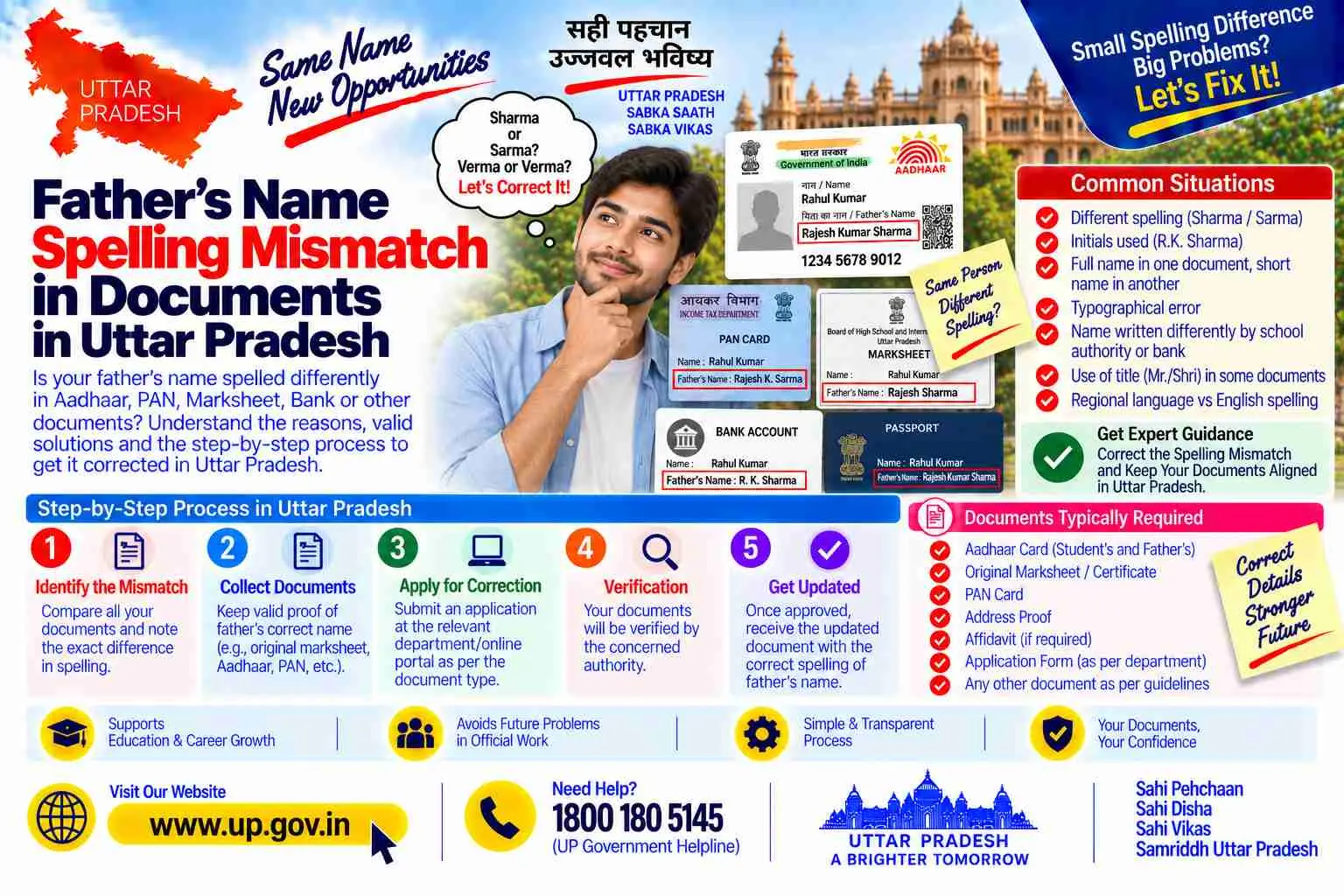
The Mismatch at a Glance
| Who decides the correct version | His own records, not your preference |
| Strongest evidence | His oldest and most formal documents |
| Do not use | The version most of your documents carry, if they copied each other |
| Fix everything? | No; fix what your future actually needs |
| The shortcut | One public notice naming several documents at once |
| Affidavit | One-and-the-same-person, naming him rather than you |
| Where it breaks | Recruitment verification, admissions, pension and property |
| Where it is tolerated | Banks and employers, with an affidavit |
Key Takeaways
- The correct version is settled by your father's own documents, which removes the question of whether it is yours to choose.
- Counting how many of your papers carry a version is misleading, because they may all descend from one wrong entry.
- A single gazette public notice can name several documents together and state his actual name, rather than fighting each counter separately.
- Correcting everything is rarely necessary; correct what recruitment, admission, pension or property will actually examine.
- Where he has passed away or his records also conflict, the oldest and most formal document leads.
Where His Name Appears: Quick Facts
| Your marksheets and certificates | Board records; correction through your school |
| Your birth certificate | Registrar; often the oldest and most useful |
| Your Aadhaar | Care-of field only, so a smaller task |
| Caste, domicile, income, EWS | Tehsil; parent name carried on each |
| Ration card | Household head or family entry |
| Your service record | Employer; often examined at promotion and retirement |
| Property and revenue records | Tehsil; inheritance depends on the link being clear |
| Passport | Parent details recorded and checked at verification |
Table of Contents
- Map the split before deciding anything
- Who decides the correct version
- Why counting documents misleads
- One notice, several documents
- Which documents to actually fix
- The harder cases
- Central Gazette: the complete process and file format
- Areas we serve
- Related guides
- Why choose our office
- FAQs
Map the Split Before Deciding Anything
Twenty minutes with a sheet of paper saves months. Write down every document of yours that names your father, the exact spelling on each, and the year it was issued.
Two columns, one for your documents and one for his, and the year matters as much as the spelling. Once it is written out, the pattern is usually obvious within a minute: a single early entry that everything downstream copied, or two separate lines of descent that never met. That picture is what decides your route, and it is invisible while the documents sit in a folder.
Who Decides the Correct Version
This is the point that resolves most of the anxiety in these cases. People agonise over whether they are entitled to choose a spelling for their father, particularly when he is elderly or no longer alive. They are not choosing, and they should not be: they are reporting what his own records show. Where his Aadhaar, his PAN and his service record all agree, the answer is settled and your documents are simply wrong in the places they differ.
Where his own records disagree, the ordering above resolves it: a service or pension record from the 1980s outweighs an Aadhaar enrolled at a camp in 2012, because the older document was created when the name was being recorded rather than copied. Our transliteration page covers the case where all the versions are legitimate renderings of one Devanagari name, which is very often what is happening here.
Why Counting Documents Misleads
The instinct is democratic: five documents say one thing, two say another, so the five must be right. That reasoning fails here for a specific reason.
| What you see | What may actually be happening |
|---|---|
| Five of your documents agree | All five were filled from one earlier document, so it is one entry repeated five times rather than five independent confirmations |
| Only your birth certificate differs | It may be the only independent record, created before the copying began |
| His Aadhaar differs from everything of yours | His Aadhaar is about him and yours are about a copy of him |
| Two clusters of documents, each internally consistent | Two separate lines of descent, usually a school line and an identity line |
So count independent origins rather than documents. A name that appears on your birth certificate, your school admission form and your father's own PAN has three genuinely separate sources agreeing; the same name on five certificates all issued from one Tehsil file has one.
One Notice, Several Documents
The route most people never hear about. A gazette public notice does not have to be about a change of name at all: it can be a correction notice, and a correction notice can name several of your documents in a single declaration.
Two things this changes. First, it can cover both parents and you together, so a family with a spread of variants does not need three separate exercises. Second, it turns your case from a claim you argue at each counter into a published record you produce, which is a much easier conversation at a Board office or an employer's HR desk.
What it does not do is amend anything by itself. Each authority still runs its own application; the notice is evidence. And note carefully that this works because you are describing your own documents, not declaring a change to your father's name, which only he could do. The full file format is set out further down this page.
Which Documents to Actually Fix
Correcting everything is expensive and usually unnecessary. Decide by what your future will examine.
- Fix, if government recruitment or examinations lie ahead: your marksheets and certificates, because document verification pulls the whole academic record.
- Fix, if higher study is planned: marksheets and any degree, since admission compares parent details across documents.
- Fix, if you are in government service: the service record, because it is re-examined at promotion and at retirement.
- Fix, if property or inheritance is involved: revenue records, where the link between father and child has to be unambiguous.
- Usually leave, with an affidavit: bank records, employer HR files in the private sector, and utility connections.
- Small task, worth doing anyway: the care-of field on your Aadhaar, which is a lighter update than a name change.
The affidavit that covers the ones you leave is the parent's-name version, where the one-and-the-same clause names your father and a separate clause establishes that you are his child. Wording is on our affidavit drafts page.
The Harder Cases
| Situation | How to approach it |
|---|---|
| He has passed away | His death certificate, surviving identity documents, pension and service records, and your birth certificate together establish the name. The case is workable; the file must be complete on arrival |
| His own records conflict | Lead with the oldest and most formal. Where he is alive, correcting his Aadhaar first gives you a settled anchor |
| He used a short form | A short form is usage rather than a different name; the full form is normally treated as correct. Say so in one line rather than leaving it unexplained |
| His name appears with and without a surname | Common in older records. The version his formal documents carry leads, and the difference is explained in the affidavit |
| Parents' names differ from each other's records | Handle them in one exercise rather than two, since a single correction notice can name both |
Central Gazette: the Complete Process and File Format
Our core service: this is the correction notice route as the file is actually drafted, in the wording the Department receives. For a father's name spread across several documents, this is frequently the cheapest way through.
Stage 1: The affidavit
Name the documents specifically. Service records, 10th and 12th class certificates, and so on. A notice that refers vaguely to "my documents" is far less useful afterwards, because the value of the whole exercise is that it identifies exactly where the wrong entries sit.
Stage 2: The Public Notice, in two copies
Each witness gives signature, full name and address, and both witnesses sign both copies. Do it at one sitting. Keep the closing certification line, which is part of the format rather than a flourish.
Stage 3: The CD and CD-Certificate
Stage 4: Newspapers, fee and covering letter
Publish in two newspapers
One Hindi daily of your district and one English paper, booked the day the affidavit is sworn. Keep complete original pages with masthead and date, and buy two copies of each edition.
Pay Rs 1,100 on BharatKosh
Before the envelope is sealed, with the function head, PAO and DDO confirmed on the confirmation screen, and two printed receipts.
Write the covering letter
Addressed to The Controller, Publication Department, Civil Line, Delhi 110054, stating that the formalities are complete and the documents are enclosed, with your mobile number and email added.
Assemble and check
Affidavit, Public Notice in two witnessed copies, CD with CD-Certificate, both newspaper pages, identity and address proof, photographs and the receipt.
Photocopy everything and courier it
Tracked dispatch, with a complete copy set kept at home so a returned file can be rebuilt.
Search Part IV after 25 to 45 days
Weekly Gazette, Part IV, a Saturday date range covering your window. Download the whole issue and note the issue number and date.
Naming Several Documents in One Notice
The specific advantage for this page's readers, and it is worth being deliberate about.
List every document you intend to correct, and leave out the ones you have decided to live with. Adding documents you will never pursue makes the notice longer without helping, and omitting one you do intend to correct means going back to that counter without support. Decide the list before drafting, using the section above on which documents actually need fixing.
Gazette Fees, Time and the File
| Affidavit | Rs 100 to 500 including stamp paper and notary |
| Adult gazette fee | Rs 1,100 on BharatKosh, once, covering all named documents |
| Newspaper advertisements | A few hundred rupees per paper, edition-dependent |
| Board correction fee | Around Rs 1,000 per application, if marksheets are involved |
| Tehsil certificate reissue | The usual application fee for each |
| Publication window | 25 to 45 days after the Department receives the file |
| Our service | Basic from Rs 999, Complete from Rs 1,999, quoted separately |
The envelope in one line: covering letter with your phone and email, affidavit (notarised), Public Notice typed in two copies with two witnesses on each, CD in MS-Word format with the signed CD-Certificate, both complete newspaper pages, photo identity proof, address proof, photographs and the BharatKosh receipt.
Before You Apply: Check These
- Map the split on paper first, with a column for his documents and a column for yours.
- Settle the correct version from his records, weighted by age and formality, not by counting your papers.
- Decide which documents you will actually correct before drafting, since the notice should name exactly those.
- Get both witnesses to sign both copies of the Public Notice at one sitting.
After the Gazette: What Updates Next
Take prints of the notice to each authority named in it: the Board through your school for marksheets, your employer for the service record, the Tehsil for certificates, and the registrar for a birth record. Each runs its own application, so plan them in sequence rather than together. Keep the notice, the affidavit, both newspaper pages and his documents in one folder, because these cases tend to resurface years later at a verification.
What Other Websites Get Wrong
- Wrong: pick whichever spelling most of your documents show. Right: his records decide it, and your documents may all copy one error.
- Wrong: correct every document that carries his name. Right: correct what recruitment, admission, pension or property will actually examine.
- Wrong: each wrong document needs its own gazette. Right: one correction notice can name several documents and both parents.
- Wrong: nothing can be done once he has passed away. Right: his surviving records establish the name perfectly well.
- Wrong: a vague notice is safer. Right: naming the exact documents is what makes it usable at each counter.
Areas We Serve in Uttar Pradesh
These cases usually span districts, since school records sit where you studied and Tehsil certificates where the family lives. We map and file them across all 75 districts, most often these:
| Western UP and NCR | Noida, Greater Noida, Ghaziabad, Meerut, Agra, Aligarh, Mathura, Bulandshahr, Muzaffarnagar, Saharanpur, Hapur, Firozabad |
| Rohilkhand and Bundelkhand | Bareilly, Moradabad, Rampur, Shahjahanpur, Budaun, Pilibhit, Bijnor, Amroha, Jhansi, Banda, Mahoba, Chitrakoot |
| Awadh and central UP | Lucknow, Kanpur, Unnao, Raebareli, Sitapur, Hardoi, Barabanki, Lakhimpur Kheri, Sultanpur, Ayodhya, Amethi, Bahraich |
| Purvanchal and eastern UP | Varanasi, Prayagraj, Gorakhpur, Azamgarh, Jaunpur, Ballia, Deoria, Mirzapur, Basti, Ghazipur, Mau, Sonbhadra |
Families from districts where school and revenue records were maintained in Hindi see this most, because one Devanagari entry rendered into English by several different hands is exactly how a father ends up with three spellings. Our chamber is at Chamber No. 19, Sadar Tehsil, Sector 5, Gomti Nagar Vistar, Lucknow 226010, with the city guide on our Lucknow page. Call 9540003316 or WhatsApp 9540005002 from any district.
Related Guides on This Site
Every guide here is part of one connected map, so whichever counter your case lands at next, the page for it already exists:
- father's name corrections: the pillar covering every document.
- father's name in a UP Board marksheet: the school and Board route in detail.
- transliteration mismatch: where every version is a legitimate rendering.
- affidavit drafts: including the parent's name version.
- correction versus change: why this is a correction throughout.
- mother's name corrections: usually handled in the same exercise.
- birth certificate correction: often the oldest independent record.
- caste certificate guide: one of the Tehsil records carrying a parent name.
- government employees: the service record and its two examinations.
- the full cost breakdown: government fees and service fees, line by line.
- contact the office: Lucknow office, phone and WhatsApp.
- father's name in Aadhaar: the Care of field and its lighter rules.
- father's name affidavit formats: four drafts and who swears each.
- birth certificate spelling correction: proving the oldest record wrong.
- parents' names on a birth certificate: the higher bar for a record made at birth.
- mother's name in a UP Board marksheet: which of her two names belongs there.
- mother's name affidavit formats: four drafts with the bridge clause.
Why We Ask for the List, Not the Story
These enquiries usually arrive as a long explanation of how the confusion arose. We ask instead for a plain list: which document, which spelling, which year. That list answers the question in a minute, and the story rarely changes the answer. Vipin Chauhan, B.Tech LL.B, has mapped many of these across whole families.
- We build the two-column map: his documents against yours, with years, which usually makes the pattern obvious immediately.
- We settle the version from his records: so you are reporting his name rather than choosing one.
- We draft one notice covering several documents: and both parents where needed, instead of repeating the exercise.
- We tell you what not to bother correcting: which is usually more of the list than clients expect.
Associate office at Chamber No. 19, Sadar Tehsil, Gomti Nagar Vistar, Lucknow, serving all 75 districts of Uttar Pradesh, Monday to Saturday, 10 AM to 6:30 PM. Call 9540003316 or WhatsApp 9540005002.
Send Us the List
Uttar Pradesh Name Change
Associate Office: Chamber No. 19, Sadar Tehsil, Sector 5, Gomti Nagar Vistar, Lucknow, Uttar Pradesh 226010
Head Office: Metro Pillar 337, Hardev Nagar, Street 1, Shop No 1 (Shri Sham Documentation)
Call: 9540003316
WhatsApp: 9540005002
Email: info@uttarpradeshnamechange.com
Hours: Mon to Sat, 10 AM to 6:30 PM
Send a list of which document carries which spelling, with years, plus photographs of your father's own documents. That is enough to settle the correct version.
Get Call and Name Change Format
Loading the enquiry form...
Father's Name Mismatch: FAQs
My father's name is spelled differently on each document. Which one is correct?
Whichever his own records carry, weighted by age and formality. Your documents are downstream copies, so they show what a clerk wrote rather than what his name is.
Can I just pick the version most of my documents show?
Not safely. Those documents may all have been filled from one earlier entry, so five agreeing papers can be one error repeated five times rather than five independent confirmations.
Do I need a separate gazette for each wrong document?
No. A single correction notice can name several documents at once, and can cover you, your father and your mother together, stating the wrong version in each and the actual names.
How specific should the notice be?
Very. Name the documents individually, such as service records and 10th and 12th class certificates, because each authority needs to find its own record named in order to act on it.
Do I have to correct every document?
No, and most people should not. Correct what your future will examine: marksheets for recruitment or higher study, the service record if you are in government service, and revenue records where property is involved.
What covers the documents I leave alone?
A one-and-the-same-person affidavit naming your father, with a separate clause establishing that you are his child. It satisfies banks, private employers and ordinary paperwork.
My father has passed away. Can this still be sorted?
Yes. His death certificate, surviving identity documents, pension or service records and your own birth certificate establish the name. Send a complete file, since nothing further can be produced later.
His own documents also disagree. What then?
Lead with the oldest and most formal, typically a service or pension record. If he is alive, correcting his Aadhaar first gives you a settled anchor to work from.
He uses a short form of his name sometimes. Is that a different name?
Normally no. A short form is usage rather than a separate name, and the full form is treated as correct. Explain it in one line in the affidavit rather than leaving it unaddressed.
Can the same notice cover my mother's name too?
Yes, and it usually should. Families with a spread of variants often find both parents affected, and handling them in one exercise saves repeating the whole process.
Does the gazette notice fix the documents by itself?
No. It is evidence, so each authority still runs its own application. What it changes is that you produce a published record instead of arguing the point at every counter.
Where does this mismatch actually cause problems?
Government recruitment verification, university admission, pension and service checks, and property or inheritance matters. Banks and private employers are usually manageable with an affidavit.
Official Sources
- The Department of Publication's guidelines for gazette notices, under which a correction notice may describe how names were wrongly recorded in an applicant's own documents.
- The Uttar Pradesh Madhyamik Shiksha Parishad correction process for parent name entries in Board records.
- UIDAI's framework for the care-of field and identity records establishing a parent's recorded name.
- Uttar Pradesh e-District practice for certificates carrying parent details.
Facts on this page are checked against these sources and our own casework, including notices covering both parents in a single filing. Office practice varies; the principle that the parent's own records settle his name is the stable core.
The Short Version
Map the split on paper first, with one column for your documents and one for your father's, including the year each was issued. His records decide the correct version, weighted by age and formality, because your documents are downstream copies that may all descend from a single wrong entry, which is why counting them misleads. Then decide what actually needs correcting: marksheets if recruitment or higher study lie ahead, the service record for government employees, revenue records where property is involved, and an affidavit for the rest. Where several documents carry the wrong version, one gazette correction notice can name them all and cover both parents together, stating the wrong entry in each and the actual names, so you produce a published record instead of arguing at every counter. Name the documents specifically, because a vague notice is one no authority can act on.