
Quick answer: Yadav and Yadaw are the same Devanagari surname, and so are Srivastava and Shrivastav, Chaudhary and Choudhry, Verma and Varma. Nobody made a mistake: your records were written in Hindi and rendered into English by different people at different times, each choosing a reasonable spelling. Because there is no error, this is always a correction and never a change, so no gazette is needed. What you must do is pick one version, make every record carry it, and keep the Devanagari original as your proof, because automated systems match strings and make no allowance for two spellings being equally right.
Ask around in Uttar Pradesh and you will find this in almost every family: a father's surname spelled one way on his service record and another on his son's marksheet, a mother who is Devi on one document and Devy on another. People treat it as carelessness, sometimes their own, and arrive expecting to be told what they did wrong. Nothing was done wrong. The state kept its registers in Hindi for generations, and English forms were filled from them by clerks, teachers and operators who each made a defensible choice about how to spell a sound. The problem is not the spelling; it is that nobody ever picked one.
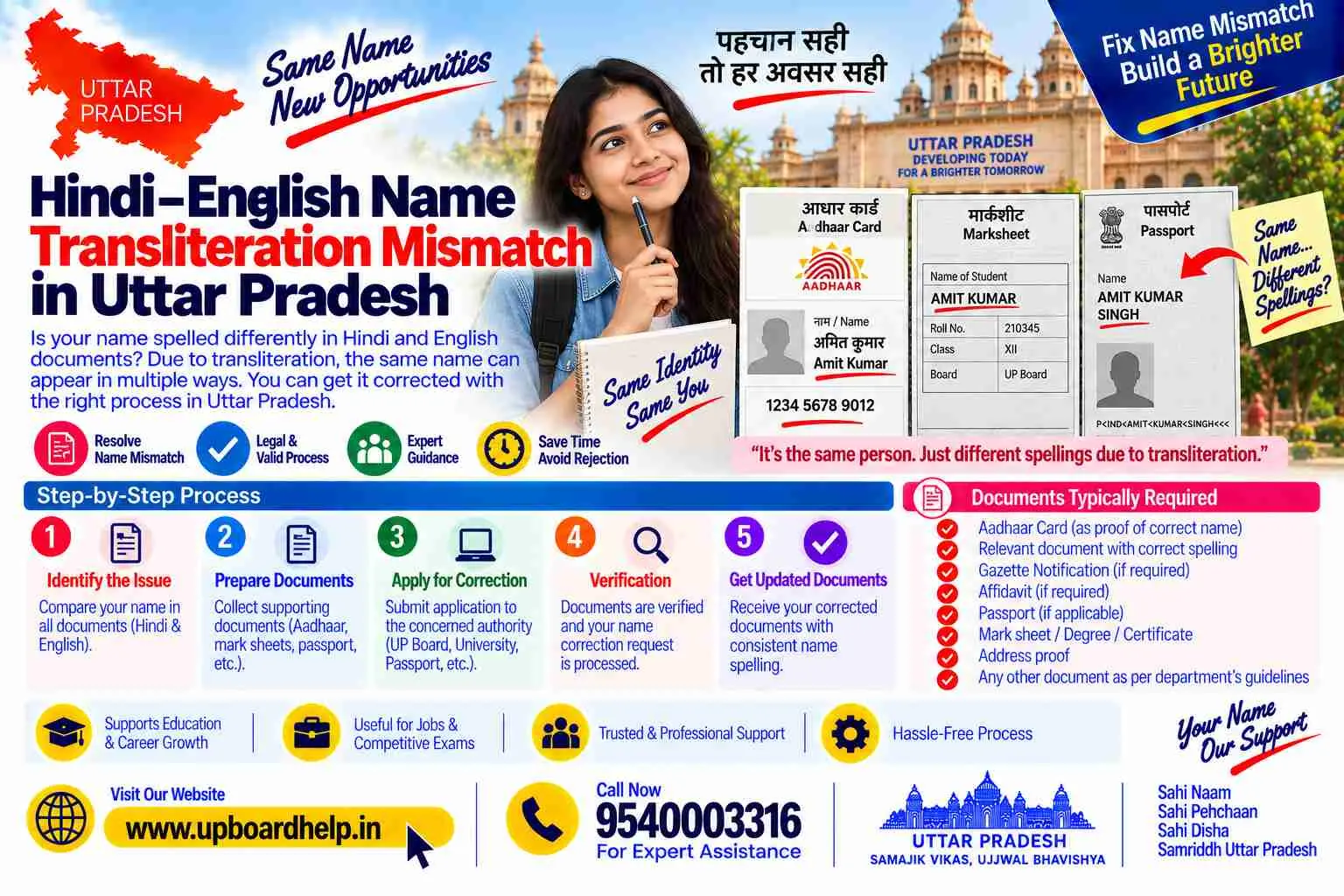
Transliteration Mismatch at a Glance
| What it is | One Devanagari name rendered into English two or more ways |
| Is it an error? | No; both spellings are legitimate renderings |
| Correction or change? | Always a correction, so no gazette is needed |
| Your strongest proof | The Devanagari entry in the original record |
| What you must do | Choose one English spelling and standardise every record |
| Where it breaks | Automated matching, which cannot see that both are right |
| Where it is tolerated | Human-read paperwork, with an affidavit |
| Typical cost | Affidavit at Rs 100 to 500, plus each authority's own fee |
Key Takeaways
- Two spellings of the same Devanagari name are both correct, which is precisely why this can never be classified as a name change.
- The Hindi entry in your original school or birth record is the strongest evidence you have, because it shows both English versions come from one source.
- You are free to choose which English spelling becomes your standard, but you must choose once and apply it everywhere.
- Automated systems match strings rather than meanings, so PAN and Aadhaar linking, scholarship portals and benefit transfers fail regardless of how reasonable your variation is.
- Where a human reads the file, an affidavit stating both refer to one person usually settles it without changing any record.
Common UP Pairs: Quick Facts
| यादव | Yadav, Yadaw, Yadava |
| सिंह | Singh, Sinh |
| श्रीवास्तव | Srivastava, Shrivastava, Srivastav |
| चौधरी | Chaudhary, Choudhary, Chaudhari, Chowdhary |
| वर्मा | Verma, Varma |
| शुक्ला | Shukla, Shukl |
| देवी | Devi, Devy |
| त्रिपाठी | Tripathi, Tripathy |
Table of Contents
- Why this happens so much here
- Nobody made a mistake, and why that matters
- The pairs you will actually meet
- Choosing your version, once
- Using the Devanagari original as proof
- Where machines refuse to be reasonable
- Central Gazette name change: step by step
- Areas we serve
- Related guides
- Why choose our office
- FAQs
Why This Happens So Much Here
Uttar Pradesh runs a great deal of its record-keeping in Hindi, and always has. Village school admission registers, revenue records, birth entries at the panchayat, all written in Devanagari. Then, over a lifetime, that name gets copied into English on a series of forms: a Board registration, a bank account opening, a PAN application, an Aadhaar enrolment. Each of those was filled by a different person at a different desk in a different decade.
Two further factors make it worse in this state. Devanagari carries sounds that English has no settled spelling for, particularly aspirated consonants and the difference between long and short vowels, so reasonable people genuinely disagree. And the person filling the form was often not you: a parent enrolling a child, a school clerk registering a batch, an operator at an enrolment camp. You inherited spellings you never chose.
Nobody Made a Mistake, and Why That Matters
This is not consolation, it is the legal heart of your case. A name change asks an authority to record something new. A correction asks it to align its record with what already exists. When two documents carry two valid renderings of one Devanagari name, nothing new is being proposed at all: you are asking that the records agree with each other. That places transliteration squarely on the correction side of the line our correction versus change page sets out, and it means no gazette notification is required.
Say this plainly in your application, because it changes how the file is read. A sentence like "both spellings are English renderings of the same name recorded in Devanagari in the school register, a copy of which is enclosed" reframes the request from a claim about identity into a matter of record consistency. Anyone selling you a Rs 1,100 publication for a Yadav-to-Yadaw difference is selling something your case does not need.
The Pairs You Will Actually Meet
| Devanagari | Spellings in circulation | What causes the split |
|---|---|---|
| यादव | Yadav, Yadaw, Yadava | The final व rendered as v or w, and a trailing vowel kept or dropped |
| सिंह | Singh, Sinh, Simha | The nasal and the aspirate written differently |
| श्रीवास्तव | Srivastava, Shrivastava, Srivastav | श as s or sh, and the final vowel kept or dropped |
| चौधरी | Chaudhary, Choudhary, Chaudhari, Chowdhary | The diphthong au written au, ou or ow |
| वर्मा | Verma, Varma | The vowel heard as e or a |
| शुक्ला | Shukla, Shukl, Sukla | The trailing vowel and the initial sibilant |
| त्रिपाठी | Tripathi, Tripathy | The final long vowel as i or y |
| प्रदीप | Pradeep, Pradip | The long vowel as ee or i |
Given names split the same way, and the last row is worth noting because people assume only surnames are affected. Pradeep and Pradip, Sunita and Suneeta, Rajeev and Rajiv are all one name each. The pattern to recognise is that the sound is identical and only the letters differ, which is the spelling test from our router page.
Choosing Your Version, Once
Because both spellings are legitimate, the choice is genuinely yours. That freedom is pleasant for about a minute and then becomes the problem, since nobody ever exercises it deliberately. Do it now, once, on purpose.
List every document and the spelling it carries
Aadhaar, PAN, bank, marksheets, passport, licence, voter ID, property papers. Count how many use each version; the majority is usually the practical choice.
Weight the documents that are hardest to change
A marksheet takes months to correct; Aadhaar takes a visit. If your Class 10 marksheet uses one spelling, that is a strong argument for adopting it rather than fighting it.
Check what your birth certificate says
Where it exists in English, it carries weight as the earliest record. Where it is in Hindi, it settles the source but not the spelling, which is fine.
Decide, and write it down
One spelling, including whether a trailing vowel stays. Tell your family, because your children's records will inherit it.
Standardise from Aadhaar outward
Aadhaar first, then PAN, then everything else, in the order our sequencing guide describes, since the same dependency chain applies.
Use it identically forever
Every form from now on. The whole point of choosing is that the choice ends the problem rather than adding a third version to it.
Using the Devanagari Original as Proof
Here is the strongest document in a transliteration case and the one almost nobody produces: the original Hindi entry. A school admission register page, a birth entry, or an old revenue record written in Devanagari does something no English document can. It shows that the two spellings in dispute both descend from a single source, which converts your claim from an assertion into a demonstration.
Ask your school for an attested copy of the relevant register page, in the same written application you use for the correction itself, following our school application guide. Where the school no longer has it, a birth entry from the registrar or an old revenue document serves the same purpose. Attach it with a one-line explanation rather than assuming the reader will make the connection.
Where Machines Refuse to Be Reasonable
Everything above works where a human being reads your file. It fails completely where a system matches text, and knowing which situation you are in saves a great deal of frustration.
- PAN and Aadhaar linking: compares names character by character and will not link Yadav to Yadaw, however obvious the equivalence. Our PAN and Aadhaar page covers this specifically.
- Scholarship and benefit portals: match against Aadhaar automatically, and failures are often silent, an application that simply never progresses with no error explaining why.
- Direct benefit transfers: bank account name against Aadhaar name, with payments failing rather than being questioned.
- Examination and recruitment portals: compare your form against your uploaded documents, so a variation stops the application.
- Foreign credential evaluation: matches names across every document you submit, and a variation reads as a discrepancy rather than a spelling choice.
The rule that follows: if any of these is in your future, standardise rather than explain. An affidavit works at a bank counter and is worth nothing to a portal. Where none of them applies, the affidavit route may serve you indefinitely, as our mismatch page sets out.
Central Gazette Name Change: Step by Step
Our core service: a pure transliteration difference does not need this. We include the route because some clients discover a genuine change alongside the spelling issue, and because knowing what a gazette involves helps you see why it is unnecessary here.
Swear the affidavit
Notarised on stamp paper with the old name, the new name, your address and the reason, in your own district.
Publish two newspaper advertisements
One Hindi daily of your district (Dainik Jagran, Amar Ujala or Hindustan) and one English paper, complete original pages kept flat.
Type the proforma and prepare the CD
Two typed copies with two witnesses giving their signature, full name and address, and the CD carrying the declaration as typed Word text.
Pay Rs 1,100 on BharatKosh
Before dispatch, with the printed receipt going into the envelope as an enclosure.
Courier the file to Civil Lines
Tracked dispatch to the Department of Publication, Delhi 110054, with your phone and email on the covering letter.
Download and run the counters
Publication in 25 to 45 days, free download, then Aadhaar, PAN, bank and the rest in order.
If You Do Publish, Spell It the Way You Mean It
One thing worth getting right for anyone who does end up publishing, for a reason beyond transliteration. The gazette prints exactly what your proforma says, letter for letter, and that printed spelling becomes the reference every institution copies afterwards.
This is the moment your lifelong spelling gets fixed in a government record, so treat it as a decision rather than a typing task. Read the proforma aloud against your intended spelling before it goes for witnessing, as our proforma guide recommends.
Gazette Fees, Time and the File
| Transliteration correction | No gazette fee at all |
| Affidavit | Rs 100 to 500 including stamp paper and notary |
| Aadhaar update | A nominal fee at a Seva Kendra |
| Board correction, where a marksheet is involved | Around Rs 1,000 per application |
| Adult gazette fee | Rs 1,100, only if a genuine change is also involved |
| Newspaper advertisements | A few hundred rupees per paper, edition-dependent |
| Our service | Basic from Rs 999, Complete from Rs 1,999, quoted separately |
The Department's checklist in one line: covering letter with phone and email, affidavit (notarised), newspapers (both, original, whole pages), proforma (typed, two copies, applicant plus two witnesses), CD with signed declaration, photo ID, address proof, photographs, BharatKosh receipt.
Before You Apply: Check These
- Confirm this is transliteration rather than a genuine difference, by checking the sound is identical and only the letters vary.
- Obtain the Devanagari original from your school, the registrar or an old revenue record, because it is your strongest proof.
- Choose your standard spelling deliberately, weighting the documents that are hardest to change.
- If any automated portal lies ahead, standardise the records rather than relying on an affidavit.
After the Gazette: What Updates Next
For a transliteration case there is usually no gazette, so the sequence is simply Aadhaar first, then PAN, then bank, employer and the rest, with any board or university record following its own chain. Keep the Devanagari copy and the affidavit filed together permanently, because the same question will be asked again years later, and having the answer ready is worth more than remembering it.
What Other Websites Get Wrong
- Wrong: one of the two spellings must be an error. Right: both are legitimate renderings of one Devanagari name.
- Wrong: a spelling difference needs a gazette. Right: transliteration is always a correction, so publication adds nothing.
- Wrong: an affidavit fixes it everywhere. Right: it works where a human reads and fails wherever a system matches.
- Wrong: change whichever document is convenient. Right: choose one standard deliberately, weighting the records that are hardest to change.
- Wrong: the Hindi record is irrelevant now. Right: it is the strongest evidence in the file and almost nobody produces it.
Areas We Serve in Uttar Pradesh
This is the most evenly distributed problem on the site, because Hindi record-keeping was the norm everywhere in the state. We handle these across all 75 districts, most often these:
| Western UP and NCR | Noida, Greater Noida, Ghaziabad, Meerut, Agra, Aligarh, Mathura, Bulandshahr, Muzaffarnagar, Saharanpur, Hapur, Firozabad |
| Rohilkhand and Bundelkhand | Bareilly, Moradabad, Rampur, Shahjahanpur, Budaun, Pilibhit, Bijnor, Amroha, Jhansi, Banda, Mahoba, Chitrakoot |
| Awadh and central UP | Lucknow, Kanpur, Unnao, Raebareli, Sitapur, Hardoi, Barabanki, Lakhimpur Kheri, Sultanpur, Ayodhya, Amethi, Bahraich |
| Purvanchal and eastern UP | Varanasi, Prayagraj, Gorakhpur, Azamgarh, Jaunpur, Ballia, Deoria, Mirzapur, Basti, Ghazipur, Mau, Sonbhadra |
Rural and semi-urban districts produce the highest share, simply because more of their older records were maintained only in Devanagari and copied into English later. Our chamber is at Chamber No. 19, Sadar Tehsil, Sector 5, Gomti Nagar Vistar, Lucknow 226010, with the city guide on our Lucknow page. Call 9540003316 or WhatsApp 9540005002 from any district.
Related Guides on This Site
Every guide here is part of one connected map, so whichever counter your case lands at next, the page for it already exists:
- correction versus change: the four tests, and why transliteration always lands on one side.
- the spelling correction pillar: the router this page sits under.
- Aadhaar name update: where standardising begins.
- PAN and Aadhaar mismatch: the commonest automated failure.
- marksheet and Aadhaar mismatch: deciding which document to change.
- UP Board marksheet correction: where the Devanagari register lives.
- the affidavit guide: including the one-and-the-same-person version.
- father's name corrections: where transliteration splits most often.
- the proforma format: where a published spelling is fixed for life.
- the full cost breakdown: what a correction route actually costs.
- contact the office: Lucknow office, phone and WhatsApp.
- affidavit drafts for spelling cases: four formats, the clause they turn on, and what to leave out.
- two different names: the three sub-cases and the alias option.
- does a correction need a gazette?: no, and the one question to ask.
- Aadhaar spelling correction: why minor is not lighter, and the document that decides.
- father's name in a UP Board marksheet: the school route and whose proof is needed.
- father's name across your documents: mapping the split and the one-notice route.
- the gram panchayat route: for a village birth record.
- birth certificate spelling correction: proving the oldest record wrong.
- mother's name in a UP Board marksheet: which of her two names belongs there.
- mother's name on a birth certificate: the date test and transitional names.
Why We Never Sell a Gazette for This
Transliteration cases are among the most common enquiries we receive and among the fewest we charge a publication fee for, because they do not need one. Saying so costs us the larger job and keeps the client. Vipin Chauhan, B.Tech LL.B, has seen every spelling pair in this state.
- We confirm it is transliteration first: identical sound, different letters, and then no publication is discussed.
- We chase the Devanagari record: the original Hindi entry that turns your claim into a comparison.
- We help you choose the standard: weighted by which documents are hardest to change, not by which is prettiest.
- We tell you when to standardise rather than explain: because an affidavit is worthless to an automated portal.
Associate office at Chamber No. 19, Sadar Tehsil, Gomti Nagar Vistar, Lucknow, serving all 75 districts of Uttar Pradesh, Monday to Saturday, 10 AM to 6:30 PM. Call 9540003316 or WhatsApp 9540005002.
Send Us Both Spellings
Uttar Pradesh Name Change
Associate Office: Chamber No. 19, Sadar Tehsil, Sector 5, Gomti Nagar Vistar, Lucknow, Uttar Pradesh 226010
Head Office: Metro Pillar 337, Hardev Nagar, Street 1, Shop No 1 (Shri Sham Documentation)
Call: 9540003316
WhatsApp: 9540005002
Email: info@uttarpradeshnamechange.com
Hours: Mon to Sat, 10 AM to 6:30 PM
Photograph the documents carrying each spelling, and the Hindi record if you have one. We will tell you which version to standardise on and what each authority needs.
Get Call and Name Change Format
Loading the enquiry form...
Transliteration Mismatch: FAQs
My documents say Yadav and Yadaw. Which one is wrong?
Neither. Both are legitimate English renderings of the same Devanagari surname, written by different people at different times. That is why this is always a correction rather than a name change.
Do I need a gazette for a spelling difference like this?
No. A gazette records a new name, and nothing new is being proposed when two spellings descend from one Devanagari original. Anyone selling you publication for a Yadav to Yadaw difference is selling something you do not need.
Why does this happen so much in Uttar Pradesh?
Because school registers, revenue records and birth entries were kept in Hindi, and English forms were filled from them by different people over decades. Devanagari also carries sounds English has no settled spelling for, so reasonable people disagree.
Which spelling should I standardise on?
Usually the one carried by the documents hardest to change, particularly your Class 10 marksheet, and by the majority of your records. The choice is genuinely yours because both are valid, but make it once and apply it everywhere.
What is my strongest proof?
The original Devanagari entry, from a school admission register, a birth record or an old revenue document. It shows both English spellings descend from one source, which turns your claim into a comparison of documents.
Will an affidavit solve it?
Where a human reads the file, usually yes. Where a system matches names automatically, no, because a portal cannot see that two spellings are equally correct. That distinction decides whether you explain or standardise.
Why does PAN and Aadhaar linking fail?
Because it compares names character by character. Yadav and Yadaw are different strings, and the system has no way to recognise that both render the same name. No amount of reasonableness helps there.
Do given names have this problem too?
Yes. Pradeep and Pradip, Sunita and Suneeta, Rajeev and Rajiv are each one name spelled two ways, for exactly the same reasons as surnames.
My father's surname is spelled differently from mine. Is that a problem?
It is common and usually resolvable the same way, particularly where his records and yours descend from the same Hindi entries. Our father's name page covers the specific case of a parent's name splitting across a child's documents.
What if I want to keep both spellings?
You can in practice, and many people do for years using an affidavit. It stops working the moment an automated system enters your life, so it is a decision to make with your future in mind rather than your present.
Should I change my children's records too?
Worth thinking about. Your children inherit whichever spelling appeared on the forms you filled, so choosing your standard now and using it consistently prevents them from repeating this exercise in twenty years.
If I do publish a gazette for other reasons, does the spelling matter?
Very much. The gazette prints exactly what your proforma says, and that spelling becomes the reference everyone copies. Decide the exact letters before typing, and use the identical string in the affidavit, both advertisements, the proforma and the CD.
Official Sources
- UIDAI's update framework, which treats an aligned spelling as a correction against supporting documents.
- The Uttar Pradesh Madhyamik Shiksha Parishad correction services, which compare against school records maintained in Hindi.
- The Department of Publication's guidelines for change of name, which define what publication is for and therefore what it is not needed for.
- Our own casework across the common spelling pairs found in Uttar Pradesh records.
Facts on this page are checked against these sources and our own experience. Institutional tolerance for variation differs widely; the correction classification and the failure of automated matching are the stable core.
The Short Version
Yadav and Yadaw, Srivastava and Shrivastav, Verma and Varma are the same Devanagari name written into English by different hands, and neither spelling is wrong. Because nothing is in error, this is always a correction and never a change, so no gazette is needed. Your strongest and least-used proof is the original Hindi entry from a school register or birth record, which shows both spellings descend from one source. What you must do is choose one English version deliberately, weighting the documents that are hardest to change, and standardise from Aadhaar outward. An affidavit satisfies any desk where a human reads the file, and satisfies no automated system at all, so if PAN linking, a scholarship portal or a recruitment process lies ahead, standardise rather than explain.