
Quick answer: Look the record up on Bhulekh by khasra or gata number rather than by name, print it, and apply to the Tehsil on the revenue side with your identity documents and the older papers showing the same holding. This is not an e-District certificate application; it is a correction to a register. Because the entry is often shared with co-holders, tell the family before you file, and expect the Tehsil to look at the chain of earlier entries rather than just at you.
Two things follow from a record being about land rather than about a person, and between them they explain nearly everything that surprises people here.
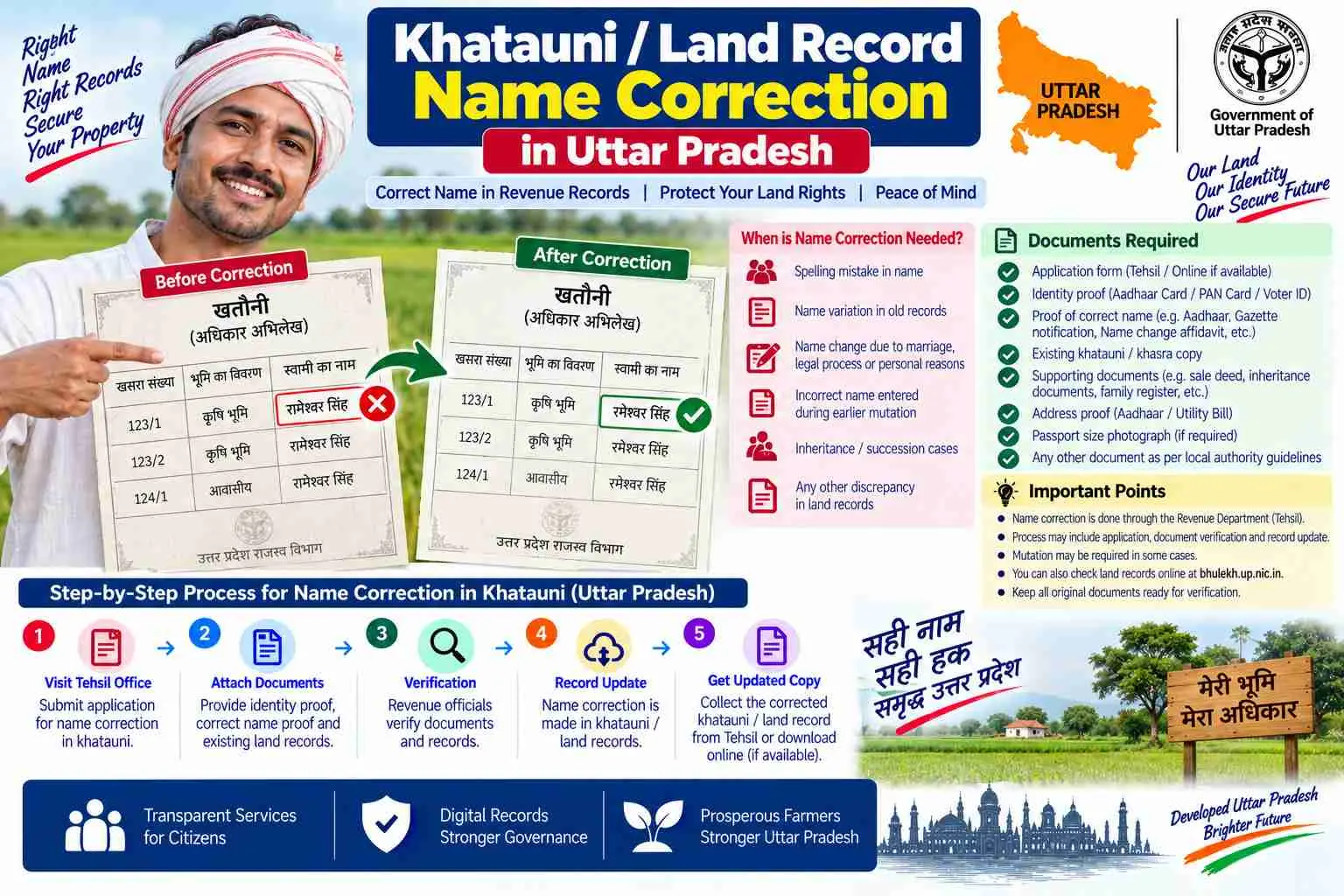
At a Glance
| Indexed by | Khasra or gata number, not by you |
| Look it up on | Bhulekh, by plot |
| Apply at | The Tehsil, revenue side |
| Not at | e-District, which handles certificates |
| Often shared | Co-holders appear in the same entry |
| Chain matters | Earlier entries are looked at |
| When it bites | Sale, mutation, loan, EWS enquiry |
| Gazette needed? | No |
Key Takeaways
- A wrong name does not put the holding at risk by itself.
- It becomes a problem at a sale, a mutation or a loan.
- The entry is often shared, so a correction touches other people.
- The spelling may be older than anything else the family holds.
- This is a revenue matter, not a certificate application.
What to Take to the Tehsil: Quick Facts
| Khatauni printout | From Bhulekh, by plot number |
| Khasra or gata number | How the record is found at all |
| Your identity proof | Aadhaar and Class 10 marksheet |
| Older entries | Showing the same holding over time |
| Purchase or inheritance papers | How the holding came to you |
| Co-holders' details | Where the entry names several people |
| Affidavit | Connecting the two spellings |
| Acknowledgment | Take one before leaving |
Table of Contents
- A record about land, not people
- The entry is usually shared
- The spelling may be the oldest one
- When it actually matters
- Applying at the Tehsil
- Finding the record first
- Central Gazette: the complete process and file format
- Areas we serve
- Key terms
- Related guides
- Why choose our office
- FAQs
A Record About Land, Not People
People arrive expecting the panic of a lost document. It is not that. It is an inconsistency waiting for a moment when somebody has to match the register against your identity proof.
The Entry Is Usually Shared
- A single Khatauni entry often names several co-holders, brothers, cousins or a joint family holding.
- So a correction touches a record other people rely on, which no personal certificate does.
- Tell the family before you file, because a change appearing without warning causes more trouble than the error did.
- Other names in the same entry may be wrong too, and it is worth reading all of them while you have the printout.
- Fixing several at once is usually easier, since the evidence and the visit are the same.
This is the practical difference between a land record and everything else on this site. A caste certificate is yours alone. A Khatauni entry belongs to a holding, and holdings usually belong to families.
The Spelling May Be the Oldest One
This is why the Tehsil looks at earlier entries rather than only at your Aadhaar. They are checking that the person being corrected is the person the chain leads to.
When It Actually Matters
| Moment | Why the name has to match |
|---|---|
| Selling the land | The registry compares the seller's ID against the record |
| Mutation after inheritance | The chain has to lead cleanly to the new holder |
| A loan against the land | A bank matches the record to the borrower |
| An EWS or income enquiry | The holding is traced to the family, as our EWS page explains |
| A dispute | Where every detail is examined closely |
Applying at the Tehsil
Print the current Khatauni from Bhulekh
By khasra or gata number, so you have exactly what the register says today.
Apply on the revenue side, not through e-District
This is a register correction rather than a certificate application, and the two go to different desks.
Carry your identity documents
Aadhaar and Class 10 marksheet, which establish the version you want recorded.
Carry the older entries and the title papers
Purchase deed, partition or inheritance papers, whatever shows how the holding reached you.
Mention the co-holders
Where the entry names several people, since the office will see them anyway.
Take an acknowledgment
And expect a local check, which is ordinary in revenue matters.
Where the correction is to your father's name rather than your own, our father's name mismatch page covers settling which version to use across the family.
Finding the Record First
- You need the khasra or gata number, which is on any earlier Khatauni, the purchase deed or the tax receipt.
- Without it, start from the village and the holder's name, which the portal supports but which is slower.
- Print what you find before applying, since it is the exact text you are asking to change.
- Read every name in the entry, not just yours, because families are usually wrong together here too.
- Note the entry details, which every conversation afterwards will start from.
Bhulekh is a viewing portal rather than an application portal, so finding the record online and correcting it are two separate activities in two separate places. That trips up people expecting a single online process.
Central Gazette: the Complete Process and File Format
Our core service: a land record correction needs no publication. Where a name is genuinely changing, this is the route from Lucknow.
Stage 1: The affidavit
Naming the village, pargana, Tehsil and plot number is what makes this affidavit usable. A land affidavit that does not identify the land is not much use to a revenue office.
Stage 2: The Public Notice, in two copies
Each witness gives signature, full name and address, and both sign both copies at one sitting. Local witnesses from the same village are worth choosing here.
Stage 3: The CD and CD-Certificate
Stage 4: Newspapers, fee, covering letter and dispatch
Publish in two newspapers and buy four copies
One Hindi daily of your district and one English paper, complete original pages.
Pay Rs 1,100 on BharatKosh
With the function head, PAO and DDO checked and two receipts printed.
Write the covering letter
To The Controller, Publication Department, Civil Line, Delhi 110054, with your mobile number and email.
Assemble, check and photocopy
A full copy set kept at home.
Courier it, tracked
One to three days from most UP districts.
Then Aadhaar, then the land record
Since the Tehsil will look at your identity documents.
Do It Before the Transaction, Not During
This is worth saying to anybody in the family who holds land, particularly older relatives who have never had reason to look at the entry since it was made.
Gazette Fees, Time and the File
| Bhulekh printout | Free to view online |
| Tehsil correction application | The revenue office's fee |
| Affidavit | Rs 100 to 500 including stamp paper and notary |
| Timeline | Driven by the local check, so allow months |
| Several names at once | Usually one visit, one set of evidence |
| Gazette | Not applicable to a register correction |
| Our service | Basic from Rs 999, Complete from Rs 1,999, quoted separately |
The envelope in one line, where publication applies to a genuine name change: covering letter with your phone and email, affidavit (notarised), Public Notice typed in two copies with two witnesses on each, CD in MS-Word format with the signed CD-Certificate, both complete newspaper pages, photo identity proof, address proof, photographs and the BharatKosh receipt.
Before You Apply: Check These
- Do you have the khasra or gata number to find the record at all?
- Are other names in the same entry also wrong?
- Have you told the co-holders what you are filing?
- Is a sale, partition or mutation planned in the next year?
After the Gazette: What Updates Next
Aadhaar first if it carries the wrong spelling, then the land record, then house tax and utility records that follow the property. Keep the old Khatauni printout alongside the corrected one, since together they show the chain and explain any older document quoting the previous spelling.
What Other Websites Get Wrong
- Wrong: search the record by your name. Right: it is indexed by khasra or gata number.
- Wrong: apply through e-District. Right: this is a revenue matter at a different desk.
- Wrong: a wrong name puts the holding at risk. Right: it becomes a problem at a sale, mutation or loan.
- Wrong: it is your record to change. Right: the entry is usually shared with co-holders.
- Wrong: the marksheet spelling is automatically older. Right: a Khatauni entry can predate it by a generation.
Areas We Serve in Uttar Pradesh
The Tehsil holding the land is the one that matters, wherever the family lives now. Across all 75 districts, most often these:
| Awadh and central UP | Lucknow, Kanpur, Unnao, Raebareli, Sitapur, Hardoi, Barabanki, Lakhimpur Kheri, Sultanpur, Ayodhya, Amethi, Bahraich |
| Purvanchal and eastern UP | Varanasi, Prayagraj, Gorakhpur, Azamgarh, Jaunpur, Ballia, Deoria, Mirzapur, Basti, Ghazipur, Mau, Sonbhadra |
| Western UP and NCR | Noida, Greater Noida, Ghaziabad, Meerut, Agra, Aligarh, Mathura, Bulandshahr, Muzaffarnagar, Saharanpur, Hapur, Firozabad |
| Rohilkhand and Bundelkhand | Bareilly, Moradabad, Rampur, Shahjahanpur, Budaun, Pilibhit, Bijnor, Amroha, Jhansi, Banda, Mahoba, Chitrakoot |
Families who moved to a city a generation ago while keeping ancestral land face this most often, and the plot number is usually the only thing anybody still remembers. Our chamber is at Chamber No. 19, Sadar Tehsil, Sector 5, Gomti Nagar Vistar, Lucknow 226010, with the city guide on our Lucknow page. Call 9540003316 or WhatsApp 9540005002 from any district.
Key Terms on This Page
Plain definitions for the words that come up at the counter:
- Khatauni
- The land record listing who holds an agricultural plot. Corrections go through the Tehsil.
- e-District
- The Uttar Pradesh portal used for caste, income, domicile and similar certificates.
- Affidavit
- A statement you swear is true, signed before a notary on stamp paper. The notary confirms you signed it, not that the contents are true.
- Name correction
- Fixing a name that was written wrongly by somebody else. Lighter than a change, because an older document already shows the right version.
- Department of Publication
- The office at Civil Line, Delhi that receives name change files and publishes the notification.
- Name change
- Adopting a different name from the one your documents correctly record. This is the case that usually needs publication.
Related Guides on This Site
Whichever counter you reach next, there is a guide for it here:
- name change in property documents: the main guide covering every situation.
- EWS and land records: why the holding is traced to the family.
- domicile corrections: where a land record is the strongest address evidence.
- father's name across documents: settling one version for the family.
- two names in different documents: the affidavit that bridges them.
- spelling correction: deciding the one version you want everywhere.
- transliteration mismatch: how a Devanagari entry became a different English spelling.
- Aadhaar name change: the document a registry will compare against.
- correction versus change: the wording that keeps this light.
- problems and mistakes: what to do when an application stalls.
- contact the office: Lucknow office, phone and WhatsApp.
- house tax records: who gets billed, which is not who owns.
- the electricity connection: a transfer, so the deposit and arrears travel.
- the registry after a gazette: a deed records a day, so it keeps the old name.
Why We Ask for the Plot Number First
Clients send us a name and we ask for a khasra or gata number, which surprises them. Without it there is no record to look at, because this register does not begin with people. Once we have it, the printout usually answers half the questions, including whether anybody else in the entry has the same problem. Vipin Chauhan, B.Tech LL.B, starts from the land.
- We start from the plot number: since that is how the record is found.
- We read every name in the entry: because families are usually wrong together.
- We ask about co-holders before filing: since a shared record deserves warning.
- We time it before a transaction: never during one.
Associate office at Chamber No. 19, Sadar Tehsil, Gomti Nagar Vistar, Lucknow, serving all 75 districts of Uttar Pradesh, Monday to Saturday, 10 AM to 6:30 PM. Call 9540003316 or WhatsApp 9540005002.
Send the Khasra Number
Uttar Pradesh Name Change
Associate Office: Chamber No. 19, Sadar Tehsil, Sector 5, Gomti Nagar Vistar, Lucknow, Uttar Pradesh 226010
Head Office: Metro Pillar 337, Hardev Nagar, Street 1, Shop No 1 (Shri Sham Documentation)
Call: 9540003316
WhatsApp: 9540005002
Email: info@uttarpradeshnamechange.com
Hours: Mon to Sat, 10 AM to 6:30 PM
Send the village, Tehsil and khasra or gata number, plus your Aadhaar spelling. Without the plot number there is no record to look at.
Get Call and Name Change Format
Loading the enquiry form...
Khatauni Name Correction: FAQs
How do I find my record?
By khasra or gata number on Bhulekh, not by your name. The register is indexed by land rather than by person.
Where do I apply?
At the Tehsil, on the revenue side. This is a register correction rather than a certificate application, so e-District is the wrong desk.
Is my land at risk because of the wrong spelling?
No. The holding is still recorded. The problem appears when somebody has to match the register against your identity proof.
When does it actually matter?
At a sale, a mutation after inheritance, a loan against the land, an EWS or income enquiry, or in a dispute.
Should I tell the co-holders?
Yes. The entry is usually shared, and a change appearing without warning causes more trouble than the error did.
Why does the Tehsil look at old entries?
Because they are checking that the person being corrected is the one the chain of entries leads to, not just matching an Aadhaar.
Which spelling should the record carry?
The one on your identity documents, while the chain of earlier entries stays traceable. That is what the Tehsil is assessing.
Can a Khatauni spelling be older than my marksheet?
Often yes, since it may come down from a grandfather's entry through partitions and mutations.
Should I wait until I sell?
No. A registry that stops mid-transaction over a spelling is far worse than an application made months earlier.
Can I do it entirely online?
No. Bhulekh lets you view and print the record; the correction is applied for at the Tehsil.
Do I need a gazette?
No. A register correction involves no publication.
How long does it take?
Allow months rather than weeks, because a local check is part of the process in revenue matters.
Official Sources
- The Uttar Pradesh Bhulekh portal, where land records can be viewed and printed by plot number.
- Tehsil revenue procedure for correction of entries in the record of rights.
- Mutation practice, under which a holding is transferred and the chain of entries maintained.
- Registry practice, under which a seller's identity is compared with the record at the time of sale.
Facts here are checked against these sources and our own casework across the state. Revenue procedure and local practice vary between Tehsils; that the record is indexed by land and usually shared is the stable part.
The Short Version
This record behaves unlike anything else in your file because it is indexed by the land rather than by you. Your marksheet is found by your name, your Aadhaar by your number, but a Khatauni is found by khasra or gata number, and your name appears inside what comes back as a detail of the plot. Two things follow. A misspelled name does not detach you from the holding, so this is less urgent than it feels, becoming a problem only when a registry, a bank or an enquiry has to match the register against your identity proof. And the entry is usually shared with co-holders, so a correction touches a record other people rely on, which no personal certificate does. Read the whole entry, tell the family before you file, and do it well before any sale or mutation rather than during one.