
Quick answer: Apply for namantaran at your Nagar Nigam or Palika with the sale deed or succession papers, the latest tax receipt, your identity documents and the property identification number. It is one of the easier applications in this whole subject. Just be clear about what it achieves: the corporation will now bill you instead of the previous name, and nothing about ownership changes, because a tax record was never where ownership lived.
Almost every question we get about house tax comes from one assumption, and it is worth clearing before anything else. People treat the tax record as a lighter version of the property papers. It is not a lighter version of anything. It is a different kind of record answering a different question.
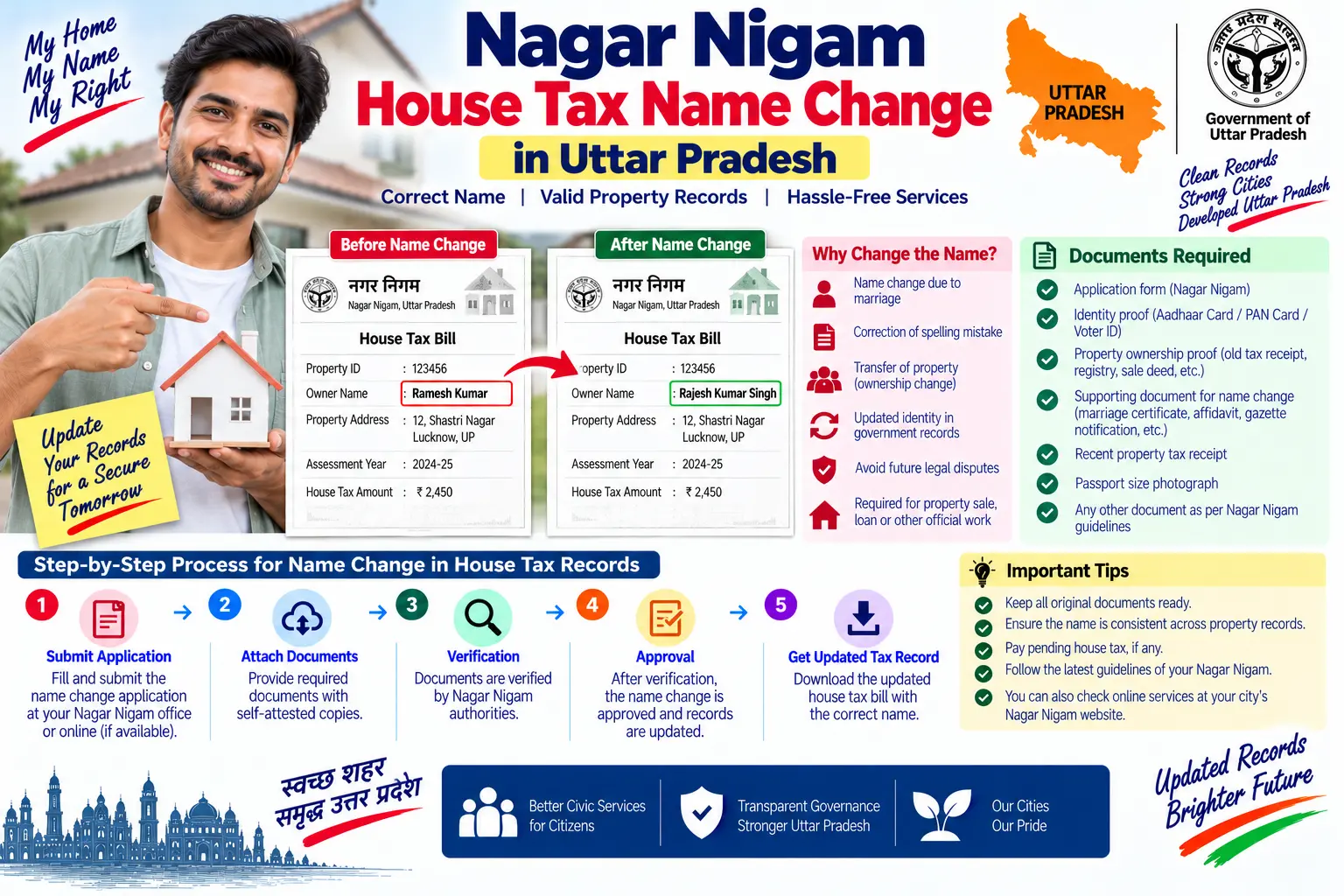
At a Glance
| What it records | Who the corporation bills |
| What it does not record | Who owns the property |
| Where to apply | Nagar Nigam, Palika or Parishad |
| The application | Namantaran, or mutation of the assessee |
| Difficulty | Among the easiest property applications |
| What it proves | Payment and occupation, not title |
| Common trigger | A sale, or a death in the family |
| Gazette needed? | No |
Key Takeaways
- The record names an assessee, not an owner.
- Changing it transfers nothing at all.
- A tax receipt is not proof of title, however often it is offered as one.
- It is the easiest property record to change and the least meaningful.
- Still worth doing, because unpaid tax follows the property.
What to Take: Quick Facts
| Property identification number | From an earlier bill or receipt |
| Latest tax receipt | Showing dues are clear |
| Sale deed | Where the property was bought |
| Succession or will papers | Where it came by inheritance |
| Death certificate | Where the assessee has died |
| Your identity proof | Aadhaar and Class 10 marksheet |
| Affidavit | Where the corporation asks |
| Acknowledgment | Take one before leaving |
Table of Contents
- Assessee, not owner
- The easiest record proves the least
- What a tax receipt actually shows
- After a sale
- After a death
- Why do it anyway
- Central Gazette: the complete process and file format
- Areas we serve
- Key terms
- Related guides
- Why choose our office
- FAQs
Assessee, Not Owner
Which explains why these applications are usually granted quickly. Nobody is adjudicating anything. They are updating a billing name, and they have no reason to be difficult about it.
The Easiest Record Proves the Least
| Record | How hard to change | What it establishes |
|---|---|---|
| Registered deed | Hardest; a rectification is a legal step | Title |
| Khatauni | Months, with a local check | The revenue record of the holding |
| House tax | Easiest; an ordinary application | Who pays the tax |
| Electricity connection | Easy | Who pays for the supply |
The registry side is on our property documents guide, and the revenue side is on our Khatauni page.
What a Tax Receipt Actually Shows
- That tax was paid, which is what it was issued for.
- That somebody was in possession, since assessees are usually occupiers.
- An address, which is why it is accepted as address evidence in many places.
- A history, where you have several years of them, which is genuinely useful for a residence claim.
- Not title, and offering it as proof of ownership in a dispute will not go well.
That fourth point is the useful one. A run of receipts over several years is strong address evidence, which our domicile page covers, because duration is what carries weight there.
After a Sale
Complete the registry first
The deed is what actually transfers the property, and the corporation will want to see it.
Clear any outstanding tax
Dues attach to the property, so a buyer inherits them along with it.
Apply for namantaran with the deed
Along with the property identification number and the latest receipt.
Give your name as your identity documents have it
Since the bill and any address evidence will carry whatever you give here.
Take an acknowledgment
And check the next bill actually arrives in the new name.
Then the electricity and water connections
Which are separate applications to separate bodies, each with its own form and its own timeline.
Buyers often leave this for a year and then discover a bill arriving in a stranger's name, or worse, arrears accumulated under it. Doing it in the same month as the registry avoids both.
After a Death
We handle these quietly and ask only for the certificate and the relationship. Families managing a bereavement are dealing with several offices at once, and this is one of the smaller ones.
Why Do It Anyway
- Because unpaid tax follows the property, not the person named, so arrears become your problem regardless.
- Because you cannot easily pay online against a record you have no login for.
- Because address evidence in your own name is worth having before you need it.
- Because a bill in a dead relative's name is an unnecessary reminder arriving twice a year.
- And because it is genuinely easy, which is not something we get to say often on this site.
None of those reasons is about ownership, and that is the point. It is worth doing for practical reasons rather than legal ones.
Central Gazette: the Complete Process and File Format
Our core service: a house tax record needs no publication. Where a name is genuinely changing, this is the route from Lucknow.
Stage 1: The affidavit
Point four is what a corporation reads first. A namantaran application over unpaid dues does not move, so clearing them is genuinely step one rather than a formality.
Stage 2: The Public Notice, in two copies
Each witness gives signature, full name and address, and both sign both copies at one sitting. None of this applies to an ordinary namantaran.
Stage 3: The CD and CD-Certificate
Stage 4: Newspapers, fee, covering letter and dispatch
Publish in two newspapers and buy four copies
One Hindi daily of your district and one English paper, complete original pages.
Pay Rs 1,100 on BharatKosh
With the function head, PAO and DDO checked and two receipts printed.
Write the covering letter
To The Controller, Publication Department, Civil Line, Delhi 110054, with your mobile number and email.
Assemble, check and photocopy
A full copy set kept at home.
Courier it, tracked
One to three days from most UP districts.
Then Aadhaar, then the tax record
Since the corporation will use your identity documents.
Do the Records in Order of Weight
This is the most useful thing on this page for anybody buying property, particularly in a family arrangement where the paperwork feels less urgent because everyone knows what was agreed.
Gazette Fees, Time and the File
| Namantaran application | The corporation's fee, usually modest |
| Outstanding tax | Must be cleared first |
| Affidavit, where asked for | Rs 100 to 500 including stamp paper and notary |
| Timeline | Among the quicker property applications |
| Death certificate copy | The registering office's fee |
| Gazette | Not applicable to this |
| Our service | Basic from Rs 999, Complete from Rs 1,999, quoted separately |
The envelope in one line, where publication applies to a genuine name change: covering letter with your phone and email, affidavit (notarised), Public Notice typed in two copies with two witnesses on each, CD in MS-Word format with the signed CD-Certificate, both complete newspaper pages, photo identity proof, address proof, photographs and the BharatKosh receipt.
Before You Apply: Check These
- Are all municipal dues cleared? Nothing moves until they are.
- Is the registry done, where the property was bought?
- Where there are several heirs, do they know you are applying?
- Are you giving your name as your identity documents have it?
After the Gazette: What Updates Next
Registry, then Khatauni where the property is rural, then house tax, then electricity and water. Keep the old receipts as well as the new ones, since a run of them across both names shows continuous payment on the property.
What Other Websites Get Wrong
- Wrong: house tax mutation transfers the property. Right: it changes who gets billed and nothing else.
- Wrong: a tax receipt proves ownership. Right: it proves payment and possession, which is not the same thing.
- Wrong: do the easy records first. Right: heaviest first, because the easy ones carry no weight.
- Wrong: one heir can quietly update it. Right: tell the others, since it changes nothing about their rights but creates arguments.
- Wrong: leave it if the bill still arrives. Right: unpaid tax follows the property to you regardless of the name.
Areas We Serve in Uttar Pradesh
Each municipal body runs its own assessment register, so this follows the town rather than the district. Across all 75 districts, most often these:
| Purvanchal and eastern UP | Varanasi, Prayagraj, Gorakhpur, Azamgarh, Jaunpur, Ballia, Deoria, Mirzapur, Basti, Ghazipur, Mau, Sonbhadra |
| Western UP and NCR | Noida, Greater Noida, Ghaziabad, Meerut, Agra, Aligarh, Mathura, Bulandshahr, Muzaffarnagar, Saharanpur, Hapur, Firozabad |
| Rohilkhand and Bundelkhand | Bareilly, Moradabad, Rampur, Shahjahanpur, Budaun, Pilibhit, Bijnor, Amroha, Jhansi, Banda, Mahoba, Chitrakoot |
| Awadh and central UP | Lucknow, Kanpur, Unnao, Raebareli, Sitapur, Hardoi, Barabanki, Lakhimpur Kheri, Sultanpur, Ayodhya, Amethi, Bahraich |
The larger corporations in Lucknow, Kanpur, Ghaziabad and Noida handle these daily and tend to be quicker; smaller Palikas may want the papers in person. Our chamber is at Chamber No. 19, Sadar Tehsil, Sector 5, Gomti Nagar Vistar, Lucknow 226010, with the city guide on our Lucknow page. Call 9540003316 or WhatsApp 9540005002 from any district.
Key Terms on This Page
Plain definitions for the words that come up at the counter:
- Khatauni
- The land record listing who holds an agricultural plot. Corrections go through the Tehsil.
- Affidavit
- A statement you swear is true, signed before a notary on stamp paper. The notary confirms you signed it, not that the contents are true.
- Department of Publication
- The office at Civil Line, Delhi that receives name change files and publishes the notification.
- Name change
- Adopting a different name from the one your documents correctly record. This is the case that usually needs publication.
Related Guides on This Site
Whichever counter you reach next, there is a guide for it here:
- name change in property documents: the main guide covering every situation.
- Khatauni and land records: the revenue record, and why it is shared.
- the Lucknow city guide: local offices and where things sit.
- domicile corrections: where a run of tax receipts is genuinely useful.
- EWS and family assets: where property is traced to a household.
- Aadhaar name change: the identity document the corporation will use.
- spelling correction: deciding the one version you want everywhere.
- two names in different documents: the affidavit that bridges them.
- correction versus change: the wording that keeps this light.
- problems and mistakes: what to do when an application stalls.
- contact the office: Lucknow office, phone and WhatsApp.
- the electricity connection: a transfer, so the deposit and arrears travel.
- the registry after a gazette: a deed records a day, so it keeps the old name.
Why We Ask What You Think It Will Achieve
People come wanting the house tax changed and expecting it to settle something larger, usually after a family conversation about who a property belongs to. It will not settle that, and it is kinder to say so before an application than afterwards. What it will do is put the bill in your name, which is worth having for reasons that have nothing to do with ownership. Vipin Chauhan, B.Tech LL.B, explains the limit first.
- We say what it does not do: before filing anything.
- We check the dues first: since nothing moves until they are cleared.
- We ask about other heirs: where a death is involved.
- We put the records in order of weight: registry first, billing records last.
Associate office at Chamber No. 19, Sadar Tehsil, Gomti Nagar Vistar, Lucknow, serving all 75 districts of Uttar Pradesh, Monday to Saturday, 10 AM to 6:30 PM. Call 9540003316 or WhatsApp 9540005002.
Send the Property ID
Uttar Pradesh Name Change
Associate Office: Chamber No. 19, Sadar Tehsil, Sector 5, Gomti Nagar Vistar, Lucknow, Uttar Pradesh 226010
Head Office: Metro Pillar 337, Hardev Nagar, Street 1, Shop No 1 (Shri Sham Documentation)
Call: 9540003316
WhatsApp: 9540005002
Email: info@uttarpradeshnamechange.com
Hours: Mon to Sat, 10 AM to 6:30 PM
Send the property identification number from an old bill, and tell us whether this follows a sale or a death. Those are different applications.
Get Call and Name Change Format
Loading the enquiry form...
House Tax Name Change: FAQs
Does changing the house tax name transfer the property?
No. The record names whoever the corporation bills, and updating it changes nothing about ownership.
Is a tax receipt proof that I own the property?
No. It proves tax was paid and somebody was in possession. Offering it as proof of title in a dispute will not go well.
What is it good for then?
Address evidence, especially a run of receipts over several years, and simply having the bill arrive in your own name.
Why is it so easy to change?
Because nothing important rests on it. The harder a property record is to change, the more it establishes.
What do I need after a sale?
The registered deed, the property identification number, the latest receipt, cleared dues and your identity documents.
What do I need after a death?
The death certificate, your relationship to the deceased, succession or will papers where they exist, and the consent of other heirs where several exist.
Can one heir apply alone?
Often the corporation will accept it, and it is better to tell the others. It changes nothing about their rights but it does create arguments.
What if there are unpaid dues?
Clear them first. A namantaran application over arrears does not move.
Do arrears become mine if the old name stays?
Effectively yes, because unpaid tax follows the property rather than the person named on the bill.
What order should I do the records in?
Registry, then Khatauni where applicable, then house tax, then electricity and water. Heaviest first.
Do I need a gazette?
No. A billing record involves no publication.
How long does it take?
It is among the quicker property applications, provided the dues are clear and the deed or succession papers are in order.
Official Sources
- Nagar Nigam, Nagar Palika and Nagar Panchayat procedure for mutation of an assessment.
- Municipal taxation practice, under which dues attach to the property.
- Registry practice, under which a registered deed transfers title.
- The Registration of Births and Deaths framework, for a death certificate supporting an application.
Facts here are checked against these sources and our own casework across the state. Local bodies differ in forms and fees; that a tax record identifies an assessee rather than an owner is the stable part.
The Short Version
A municipal tax record answers one question: who should the corporation send the bill to. It does not record who owns the property, which is why the name on it is so often an owner from two sales ago or a father who died years back, and why nobody at the counter treats that as an error. So this application is quick and it transfers nothing. There is a pattern worth seeing here: the harder a property record is to change, the more it establishes, and this is the easiest of them all. A registered deed is hardest and carries title; a Khatauni takes months and carries the revenue record; a tax record takes an ordinary application and carries the billing name. Anybody telling you a tax receipt settles a question of ownership is contradicted by how easily one can be obtained. Do it anyway, because unpaid tax follows the property to you regardless of whose name is on the bill.