
Quick answer: There is no time limit on correcting a name in a UP Board record. The hard three-year window that people have heard about applies to date of birth, and the two get confused into a belief that nothing can be done after school. Old records are handled through the modified marksheet and revised certificate route, with the same chain of school, DIOS and Board. What changes with age is not your right to apply but where the evidence comes from, because a register from 2004 has to be located rather than opened. Where the school record genuinely cannot be found, a gazette notification becomes the cleaner route.
We meet this case constantly and almost always in the same shape: someone in their thirties or forties, a marksheet carrying a misspelling nobody noticed in 2005, and a settled belief that the chance to fix it expired long ago. Usually a school clerk or a neighbour said "limit khatam ho gaya" once, and that ended the enquiry. The limit they were thinking of is real, but it is the date of birth limit, and applying it to names has probably cost more people more years than any other misunderstanding in this subject.
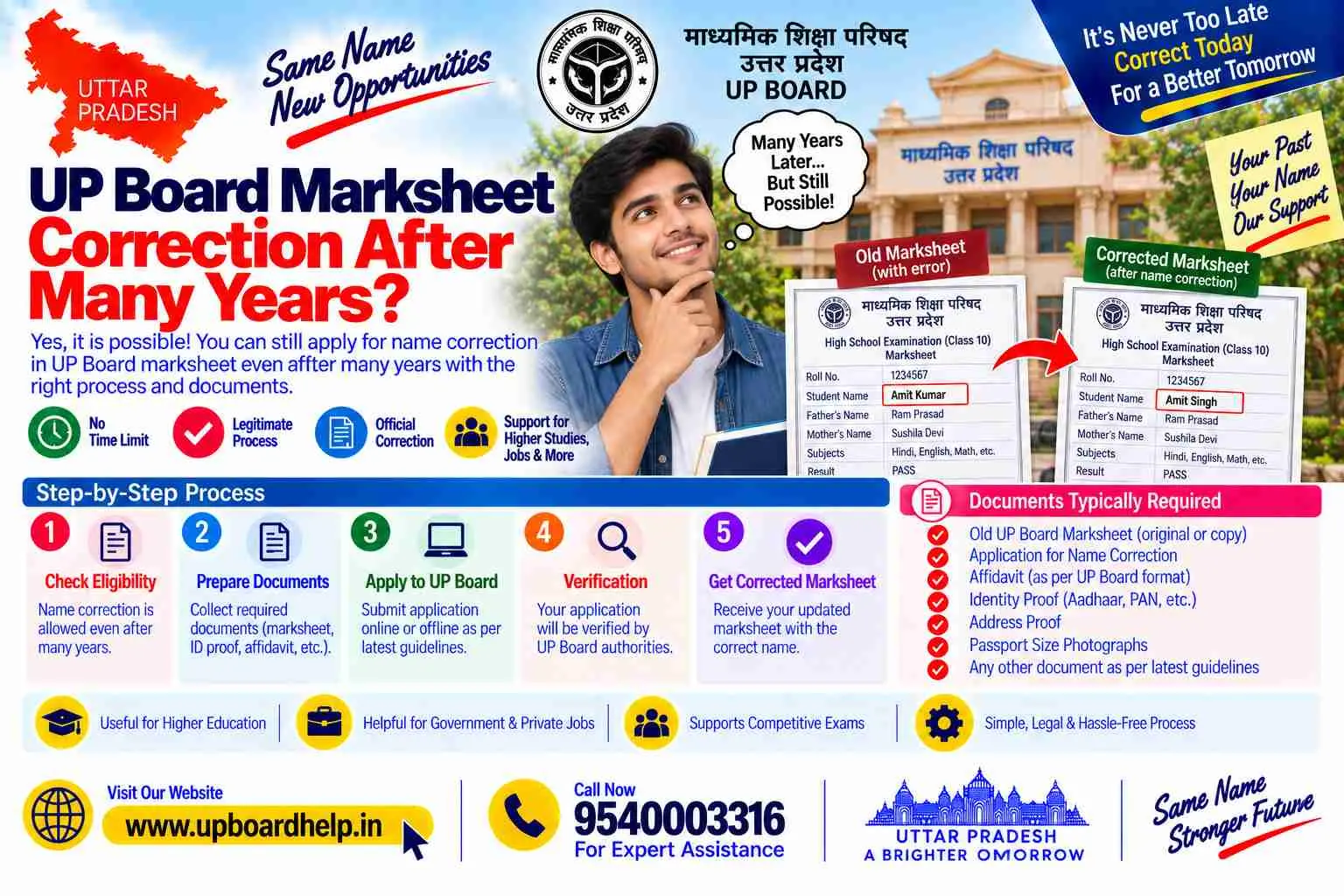
Old Corrections at a Glance
| Time limit on name correction | None |
| Time limit on date of birth | Three years from passing, and it is hard |
| Route for old records | Modified marksheet and revised certificate |
| Same chain? | Yes: school, Principal, DIOS, Board |
| What gets harder | Locating the school register, not the entitlement |
| Your hidden strength | Decades of consistent usage across other records |
| When to publish instead | When the school record cannot be traced at all |
| Fee | Around Rs 1,000, the same as a recent case |
Key Takeaways
- The three-year limit belongs to date of birth corrections, and applying it to names is the reason most old cases are abandoned without being tried.
- The process is unchanged for an old record; what changes is that the school has to locate a register rather than open the current one.
- Years of consistent usage across bank, PAN and employment records are evidence in your favour, not a complication.
- Where no school record survives, a gazette notification becomes the strongest and often the only clean route.
- Sometimes the sensible decision is to leave the marksheet alone and carry an affidavit, and that depends entirely on what lies ahead.
What Age Changes: Quick Facts
| The application | Identical, through your school |
| The fee | Around Rs 1,000, unchanged |
| The register | Has to be located; may be in storage or with the DIOS |
| Staff memory | Nobody present will remember your batch, which is fine |
| Supporting documents | More important, because the register is harder to reach |
| Realistic timeline | Longer, because of the search rather than the decision |
| If the school closed | The DIOS holds district records |
| If nothing survives | Gazette, then apply with the notification enclosed |
Table of Contents
- The limit that does not exist
- What actually changes with age
- The evidence you already have
- Finding a register from twenty years ago
- When publishing is the cleaner route
- When to leave the marksheet alone
- Central Gazette name change: step by step
- Areas we serve
- Related guides
- Why choose our office
- FAQs
The Limit That Does Not Exist
Both facts are true and they belong to different things. The confusion is understandable, because a school office asked about "correction" often answers with the rule they hear most, and that rule is the date of birth one. If someone has told you the window has closed on a name, ask them which rule they are applying, and ask for it in writing, as our school refusal guide sets out. The date of birth position, which is genuinely restrictive, is covered on our date of birth page.
What Actually Changes With Age
| Stage | Recent record | Old record |
|---|---|---|
| Your entitlement to apply | Unrestricted | Unrestricted, identically |
| The application route | Through the school | Through the school, same chain |
| The fee | Around Rs 1,000 | Around Rs 1,000 |
| Finding your entry | Current register, minutes | Archived register, possibly days or weeks |
| Staff familiarity | May remember the batch | Nobody present taught you, which is normal |
| Weight of your other documents | Supporting | Central, because they carry the argument |
| Overall time | Months | Longer, because of searching rather than deciding |
Read down the table and the pattern is clear: nothing about the rules changes, and everything about the logistics does. That is why an old case succeeds or fails on preparation rather than on argument. Arrive with a complete file and a specific reference, your examination year, roll number and registration number, and the school's task becomes a search with clear parameters rather than a vague request about the past.
The Evidence You Already Have
This is the part people do not think of as evidence, and it is often the strongest thing in the file. Someone who left school twenty years ago has been living under the correct name the entire time, and that leaves a trail:
- Bank accounts opened years ago in the correct name, with statements showing continuous use.
- PAN card and income tax records in the correct name, which are hard to dismiss.
- Employment records and salary slips, and a service book if you are in government service.
- Your children's school forms, where you appear as parent under the correct name.
- Property, utility and insurance documents accumulated over the decades.
- Passport, driving licence and voter ID, each independently issued against identity proof.
Presented together, these do something a recent applicant cannot do: they show that the marksheet is not one version of a disputed name but a single outlier against twenty years of consistent record. That framing matters, because it points the Board toward a correction reading rather than a change reading, which is the distinction that decides whether a gazette is demanded, as our correction versus gazette page explains. Attach the strongest four or five rather than everything you own; a file that argues clearly beats a file that is merely thick.
Finding a Register From Twenty Years Ago
Give the school a precise reference
Examination year, roll number, registration number and the section if you remember it. A search with parameters is a task; a search without them is a favour.
Ask in writing, with your documents attached
The written application converts an awkward request about old paperwork into an office file with a date, which is what makes it move.
Expect the register to be in storage
Old admission and scholar registers are usually archived rather than lost. Allow days rather than expecting an answer at the counter.
If the school cannot locate it, go to the DIOS
District records exist independently of the school, and the DIOS office is the correct next stop rather than a complaint.
If the school has closed or merged
Approach the absorbing institution first, since records usually travel with a merger, then the DIOS if that fails.
If nothing survives anywhere
Stop searching and change route: publish a gazette, then apply with the notification enclosed. This is the situation the next section covers.
When Publishing Is the Cleaner Route
There is a point at which continuing to chase a twenty-year-old register stops being sensible, and recognising it saves months. If the register cannot be located, the school has closed and district records do not resolve it, then the Board has nothing to verify your correction against, and no amount of persistence changes that. At that point a gazette notification does something the missing register cannot: it creates a current, public, verifiable record of the name you use, which the Board and every other institution can rely on.
Two honest notes about this path. It costs more, Rs 1,100 plus newspaper insertions on top of the Board fee, so it is a fallback rather than a first choice. And it changes the character of the application from "correct this entry" to "record this published change", which the Board treats differently. But for someone who has spent a year being told the register cannot be found, it is often the first thing that actually moves.
When to Leave the Marksheet Alone
The question worth asking before starting any of this: who is going to look at this marksheet again? For someone at forty-five, settled in a job, with no further study planned and no government recruitment ahead, the honest answer may be nobody. In that case a one-and-the-same-person affidavit costing a few hundred rupees explains the difference wherever it arises, and the correction becomes optional rather than necessary.
Where that reasoning breaks, and it breaks predictably, is if any of these lie ahead: further study, a government examination or recruitment, a professional registration, or a pension or service verification that pulls your academic record. Government service in particular tends to re-examine documents at promotion and at retirement, which is why serving employees should correct rather than explain. Our mismatch page sets out where affidavits work and where they do not.
Central Gazette Name Change: Step by Step
Our core service: for old cases where records cannot be traced, or where the Board reads the case as a change, this is the filing our office runs from Lucknow every week.
Swear the affidavit
Notarised on stamp paper with the name on the marksheet, the name you use, your address and the reason, in your own district.
Publish two newspaper advertisements
One Hindi daily of your district (Dainik Jagran, Amar Ujala or Hindustan) and one English paper, complete original pages kept flat.
Type the proforma and prepare the CD
Two typed copies with two witnesses giving their signature, full name and address, and the CD carrying the declaration as typed Word text.
Pay Rs 1,100 on BharatKosh
Before dispatch, with the printed receipt going into the envelope as an enclosure.
Courier the file to Civil Lines
Tracked dispatch to the Department of Publication, Delhi 110054, with your phone and email on the covering letter.
Download and take it to the school
Publication in 25 to 45 days, free download, prints made, and the notification enclosed with the school application.
One Detail Old Cases Get Wrong in the Proforma
A gazette declaration for an old marksheet has a wrinkle worth catching before dispatch. The proforma asks for your name as it currently stands, and applicants who have used the correct name for twenty years instinctively write that as the old name, because it is the name they use.
The declaration has to bridge the two names that appear on paper, not the two names in your head. Where your Aadhaar and PAN already carry the correct name and only the marksheet differs, say so plainly in the covering letter, because it explains why the change appears one-sided. The full specimen is on our proforma guide.
Gazette Fees, Time and the File
| Board correction fee | Around Rs 1,000, same for an old record as a recent one |
| Affidavit | Rs 100 to 500 including stamp paper and notary |
| Adult gazette fee | Rs 1,100 on BharatKosh, where records cannot be traced or the case is a change |
| Newspaper advertisements | A few hundred rupees per paper, edition-dependent |
| Publication window | 25 to 45 days after the Department receives the file |
| Register search | No fee, but allow real time |
| Our service | Basic from Rs 999, Complete from Rs 1,999, quoted separately |
The Department's checklist in one line: covering letter with phone and email, affidavit (notarised), newspapers (both, original, whole pages), proforma (typed, two copies, applicant plus two witnesses), CD with signed declaration, photo ID, address proof, photographs, BharatKosh receipt.
Before You Apply: Check These
- Confirm which limit you were told about, because the three-year rule is for date of birth and not for names.
- Gather your examination year, roll number and registration number before approaching the school, since a precise reference makes the search possible.
- Assemble four or five strong documents showing decades of consistent usage rather than everything you own.
- Set a point at which you stop chasing the register and publish instead, rather than searching indefinitely.
After the Gazette: What Updates Next
Once the corrected marksheet issues, the other class follows if both were affected, then any degree or professional registration. For someone correcting after many years, the useful additional step is telling your employer, so the service record reflects the corrected document, and checking whether any pension or provident fund record carries the old name. Keep the old marksheet, the corrected one and the gazette together permanently, because a verifier looking at a twenty-year gap will want the link explained.
What Other Websites Get Wrong
- Wrong: the correction window closes three years after passing. Right: that limit is for date of birth; names have no deadline.
- Wrong: old records are lost, so nothing can be done. Right: registers are archived rather than destroyed, and district records exist beyond the school.
- Wrong: years of using a different name weakens your case. Right: consistent usage across bank, PAN and employment records is evidence in your favour.
- Wrong: an old case costs more at the Board. Right: the fee is the same; only the search takes longer.
- Wrong: keep pursuing the school until the register turns up. Right: where nothing survives, publish a gazette instead of searching indefinitely.
Areas We Serve in Uttar Pradesh
Old cases are the ones where district matters most, because the register sits where you studied and may have moved to a district archive since. We trace and file these across all 75 districts, most often these:
| Rohilkhand and Bundelkhand | Bareilly, Moradabad, Rampur, Shahjahanpur, Budaun, Pilibhit, Bijnor, Amroha, Jhansi, Banda, Mahoba, Chitrakoot |
| Awadh and central UP | Lucknow, Kanpur, Unnao, Raebareli, Sitapur, Hardoi, Barabanki, Lakhimpur Kheri, Sultanpur, Ayodhya, Amethi, Bahraich |
| Purvanchal and eastern UP | Varanasi, Prayagraj, Gorakhpur, Azamgarh, Jaunpur, Ballia, Deoria, Mirzapur, Basti, Ghazipur, Mau, Sonbhadra |
| Western UP and NCR | Noida, Greater Noida, Ghaziabad, Meerut, Agra, Aligarh, Mathura, Bulandshahr, Muzaffarnagar, Saharanpur, Hapur, Firozabad |
Rural and older institutions produce the majority of these enquiries, usually because a register was archived rather than lost, and because nobody currently at the school was there when you were. Our chamber is at Chamber No. 19, Sadar Tehsil, Sector 5, Gomti Nagar Vistar, Lucknow 226010, with the city guide on our Lucknow page. Call 9540003316 or WhatsApp 9540005002 from any district.
Related Guides on This Site
Every guide here is part of one connected map, so whichever counter your case lands at next, the page for it already exists:
- the main UP Board correction guide: the approval chain, documents and fees.
- when the school will not forward: the written application and DIOS escalation.
- date of birth correction: the limit that genuinely is hard.
- correction versus gazette: which route your case needs, and why.
- marksheet and Aadhaar mismatch: where an affidavit works and where it does not.
- Class 10 and Class 12 corrections: order and the four documents.
- the Samadhan portal guide: tracking, uploads and status meanings.
- the proforma format: the specimen and the old name field.
- government employees: service record and pension implications.
- the full cost breakdown: government fees and service fees, line by line.
- contact the office: Lucknow office, phone and WhatsApp.
- cbse marksheet correction: Bye-law 69.1, a real time limit, and what remains once the window closes.
- father's name in a UP Board marksheet: the school route and whose proof is needed.
Why Age Has Never Stopped a File Here
The most common sentence in these enquiries is that somebody said it was too late. In five years of filing we have not had a name correction refused for age alone, though we have had plenty slowed by registers that took finding. Vipin Chauhan, B.Tech LL.B, has handled records going back decades.
- We check which limit you were quoted: the three-year rule is real and it is not about names.
- We build the usage evidence: the bank, PAN and employment trail that shows the marksheet is the lone outlier.
- We know when to stop searching: and switch to publication rather than letting a case drift for a year.
- We say when the marksheet can be left alone: if nothing ahead will look at it, an affidavit may genuinely be enough.
Associate office at Chamber No. 19, Sadar Tehsil, Gomti Nagar Vistar, Lucknow, serving all 75 districts of Uttar Pradesh, Monday to Saturday, 10 AM to 6:30 PM. Call 9540003316 or WhatsApp 9540005002.
Tell Us the Year
Uttar Pradesh Name Change
Associate Office: Chamber No. 19, Sadar Tehsil, Sector 5, Gomti Nagar Vistar, Lucknow, Uttar Pradesh 226010
Head Office: Metro Pillar 337, Hardev Nagar, Street 1, Shop No 1 (Shri Sham Documentation)
Call: 9540003316
WhatsApp: 9540005002
Email: info@uttarpradeshnamechange.com
Hours: Mon to Sat, 10 AM to 6:30 PM
Send the marksheet, your passing year and roll number, and tell us what the school has already said. Age alone has never been a reason we could not file.
Get Call and Name Change Format
Loading the enquiry form...
Correction After Many Years: FAQs
Is there a time limit for correcting a name on a UP Board marksheet?
No. The three-year limit people have heard about applies to date of birth corrections, not names. Old records are handled through the modified marksheet and revised certificate route, with the same school, DIOS and Board chain.
I passed in 2004. Is it really still possible?
Yes. What changes is that the school has to locate an archived register rather than open the current one, so allow more time. Your entitlement, the route and the fee are unchanged.
Does it cost more because the record is old?
No. The Board's correction fee is around Rs 1,000 either way. Costs only rise if the record cannot be traced and a gazette becomes necessary.
The school says the limit is over. What should I say?
Ask which rule they are applying, and ask for the refusal in writing. The three-year rule is a date of birth rule, and a written position usually resolves the confusion quickly.
Does using a different name for twenty years hurt my case?
The opposite. Consistent usage across bank accounts, PAN, employment records and your children's school forms shows the marksheet is a lone outlier rather than a disputed name, which points the Board toward a correction reading.
What if the school cannot find my register?
Go to the DIOS office, which holds district records independently. If the school has merged, approach the absorbing institution first, since records usually travel with a merger.
What if no record survives anywhere?
Publish a gazette and apply with the notification enclosed. It creates a current public record of your name, which is something a missing register cannot provide however long you search for it.
Should I correct it at all if I am settled in a job?
It depends on what lies ahead. With no further study, recruitment, professional registration or service verification coming, an affidavit may serve. Government employees should correct, because records are re-examined at promotion and retirement.
What do I write as the old name in a gazette proforma?
The name as printed on the marksheet, even though you have not used it for years. The declaration bridges the two names on paper, not the two names in your head.
How long does an old case take?
Longer than a recent one, though the extra time is the register search rather than the decision. Budget several months, and more if the school has closed.
Which documents should I attach?
Four or five strong ones rather than everything: Aadhaar, birth certificate, PAN, a long-held bank record and an employment document. A file that argues clearly beats a file that is merely thick.
Can I fix my date of birth too, after all these years?
Not through this route. The date of birth limit is genuinely hard, and after it the remaining path is a court order rather than the Board.
Official Sources
- The Uttar Pradesh Madhyamik Shiksha Parishad's modified marksheet and revised certificate services, through which older records are corrected.
- The Board's date of birth correction rule, limited to three years from passing, which is the limit commonly misapplied to names.
- The school Principal and District Inspector of Schools verification chain, unchanged for old records.
- The Department of Publication's gazette requirements, used where school records cannot be traced.
Facts on this page are checked against these sources and our own casework on records going back decades. Office practice varies; the absence of a name deadline and the shift of difficulty from entitlement to evidence are the stable core.
The Short Version
There is no deadline for correcting a name in a UP Board record. The three-year limit people quote belongs to date of birth corrections, and confusing the two has cost more people more years than anything else in this subject. Old records go through the modified marksheet and revised certificate route with the same school, DIOS and Board chain, and the same fee of around Rs 1,000. What changes is logistics: an archived register has to be located, so give the school your examination year, roll number and registration number, ask in writing, and expect days rather than minutes. Decades of consistent usage across bank, PAN and employment records are evidence in your favour. And when no record survives anywhere, stop searching and publish a gazette instead, because that creates a current public record where the missing register cannot.