
Quick answer: An EWS certificate name issue in Uttar Pradesh is fixed by issuing a fresh certificate, not by correcting the old one: the certificate runs on a financial-year clock, recruitments and admissions want a current-year issuance, and UP issues it free through e-District and the Tehsil, with Aadhaar e-KYC filling your name from UIDAI. Fix Aadhaar first if it is wrong, check whether your recruitment wants the Government of India format, and apply fresh, the certificate lands in roughly 7 to 30 days.
The EWS certificate, formally the Income and Asset Certificate for Economically Weaker Sections, is the 10% general-category reservation's key, and it has one property that makes every "name correction" debate on it pointless: it is an annual document. Central recruitments and admissions want a certificate issued in the current financial year, which means you will be back at the Tehsil next year regardless of what this year's paper says. So the honest question is never "how do I correct my EWS certificate", it is "how do I make this year's certificate come out right", and the answer has three parts: Aadhaar first (e-KYC prints its spelling), the parents' and family names reconciled (they are typed), and the right format chosen for your purpose. UP sweetens the deal by issuing it free.
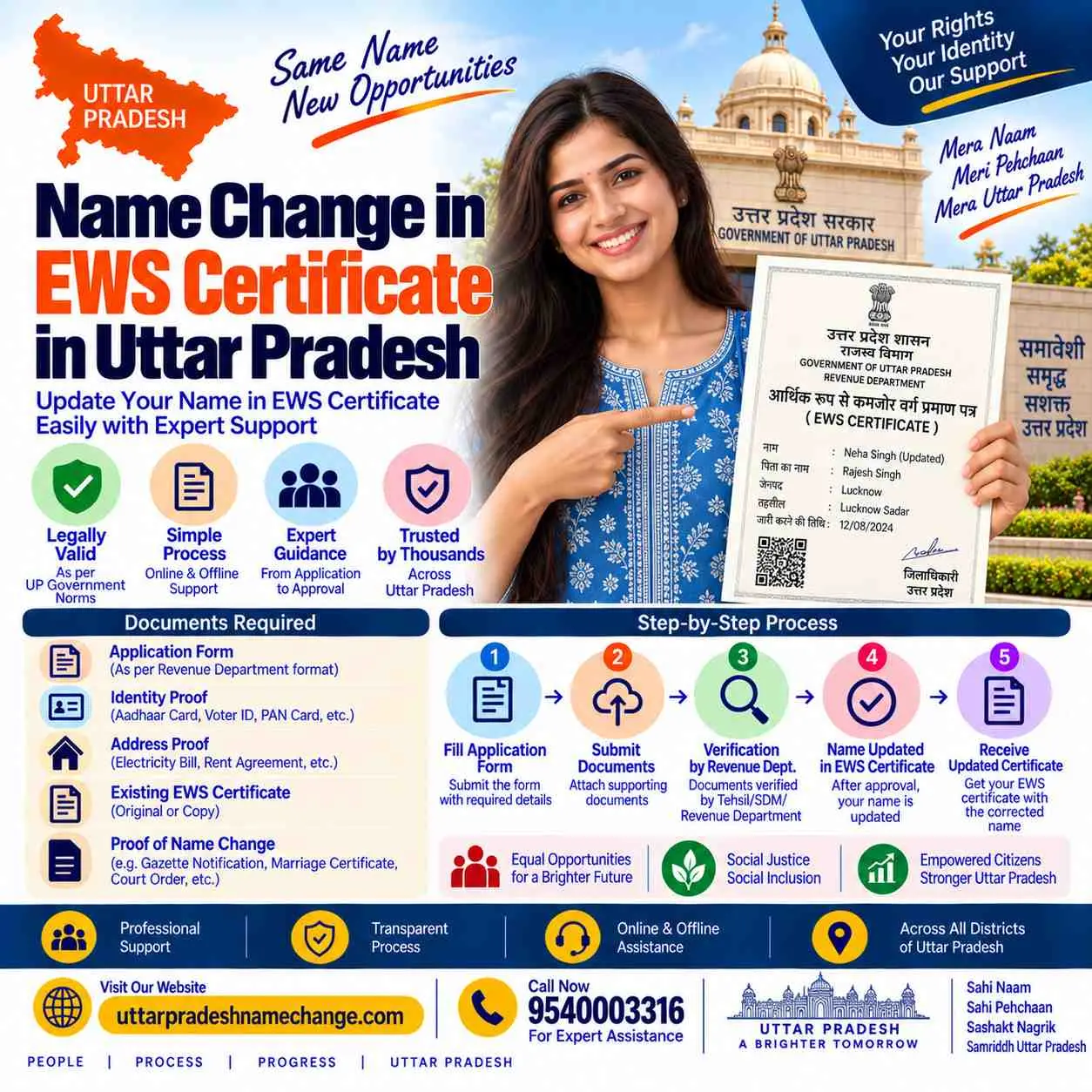
EWS Certificate Name Work at a Glance
| What it is | The Income and Asset Certificate for EWS: 10% reservation for the general category |
| The clock | Financial-year validity in practice; recruitments want a current-year issuance |
| The fix, therefore | A fresh certificate born right, never a correction of the old one |
| The name rule | Aadhaar e-KYC fills your name; parents' and family names are typed |
| Eligibility core | Family income below Rs 8 lakh plus the asset tests |
| Who issues it | The Tehsildar through e-District UP, after Lekhpal verification |
| Cost and time | Free in UP (about Rs 20 via CSC); roughly 7 to 30 days |
Key Takeaways
- The EWS certificate is effectively annual: current-financial-year issuance is what recruitments and admissions check first, so this year's fresh certificate is both the fix and the requirement.
- Aadhaar leads again: e-KYC fills your name from UIDAI, so a wrong Aadhaar means a wrong certificate, and the Seva Kendra visit comes before the Tehsil application.
- Check the format before applying: central recruitments and IIT-NIT admissions want the Government of India annexure format signed by the Tehsildar, and a state-format paper at a central verification desk is a rejected document.
- It is a family certificate: the income is the family's, the father's or husband's name prints beside yours, and their spelling mismatches fail verification exactly like your own.
- UP issues it free; a CSC charges about Rs 20 for the filing. Anything beyond that quoted as "government fees" is padding.
UP EWS Certificates: Quick Facts
| Full name | Income and Asset Certificate for Economically Weaker Sections |
| Reservation | 10% in central and UP government jobs and admissions, general category only |
| Income test | Gross family income below Rs 8 lakh in the previous financial year |
| Asset tests | No 5+ acres of agricultural land, no 1,000+ sq ft flat, no large residential plots per the central criteria |
| Portal | e-District UP with eSathi login, or any CSC; Gramin or Nagariya selected by residence |
| Issuing authority | Tehsildar, on Lekhpal verification |
| Cost | Free in UP; about Rs 20 CSC service charge |
| Adjacent fact | UP's plain income certificate runs 3 years, but EWS wants current-year issuance |
Table of Contents
- The annual clock: why corrections are pointless
- Central vs state format: the heading confusion
- The Rs 8 lakh income and asset tests
- The fresh application, step by step
- A family certificate: the names beside yours
- Marriage cases and whose family counts
- The verification stakes
- Fees and honest timelines
- Central Gazette name change: step by step
- What other websites get wrong
- The three EWS questions
- Areas we serve
- Why choose our office
- Key terms
- Related guides
- FAQs
The Annual Clock: Why Corrections Are Pointless
Every recruitment notice and admission brochure that accepts EWS says some version of the same line: the income and asset certificate must be issued in the current financial year (or for the relevant year the notice names). That single requirement dissolves the entire "correction" question. The certificate you hold expires from the desk's point of view every April anyway; chasing a Tehsil correction on a paper that will be replaced in months is effort spent on a dying document. The working rule, stronger here than anywhere else in this series: fix the anchors, apply fresh, and let the annual cycle do the retiring. Your one job is making sure the fresh certificate is born right, which the next three sections cover: the format, the tests, and the names.
Central vs State Format: the Heading Confusion
Applicants regularly panic on seeing "Government of India" printed atop a certificate their UP Tehsildar signed, or the reverse, and forums are full of "will mine be valid?" threads. The decode is simple: the EWS reservation is a central scheme with a prescribed central annexure format, and central recruitments (UPSC, SSC, banking) and central admissions (IIT, NIT, central universities) want that Government of India format, issued and signed by your local authority, the Tehsildar, exactly as your caste-certificate cousins are. UP's own recruitments and institutions run comfortably on the state's e-District output. The practical discipline: open the recruitment or counselling notice, find the annexure it prescribes, and carry that format to the Tehsil or attach it to the e-District application. Ten minutes of notice-reading saves a rejected document at verification, because the desk matches the format before it reads a single name.
The Rs 8 Lakh Income and Asset Tests
Eligibility runs on two gates, both about the family, not just you. The income gate: gross family income below Rs 8 lakh in the financial year before application, counting all sources, salary, agriculture, business, and all family members as the scheme defines them. The asset gate, from the central criteria: the family should not own 5 acres or more of agricultural land, a residential flat of 1,000 sq ft or more, or residential plots above the notified sizes in municipal and non-municipal areas. The Lekhpal verifies these claims in the field, which is why honest, consistent declarations matter: an EWS certificate obtained on understated assets is a career-ending discovery at a later verification, and the desks do check. None of this touches names directly, but it decides whether the certificate exists at all, so it belongs in the same preparation pass.
The Fresh Application, Step by Step
Fix Aadhaar first
The e-District family runs Aadhaar e-KYC, and your name prints as UIDAI records it. Marriage certificate, gazette or corrected documents update Aadhaar at the Seva Kendra before anything else.
Read the notice and fix the format
Central recruitment or admission: the Government of India annexure. UP-state purposes: the e-District output. The notice's annexure decides, not habit.
Apply on e-District or through a CSC
eSathi login, Gramin or Nagariya by actual residence, e-KYC OTP, then the typed fields: the father's or husband's name exactly as his documents print it, family members, income and asset declarations, with the self-declaration and proofs uploaded.
Save the application number
The filing is free in UP, about Rs 20 through a CSC, and the application number is the handle for tracking and for every verification desk later.
Clear Lekhpal verification and download
Field verification of income and assets, Tehsildar issuance, and the certificate lands on the portal and DigiLocker in roughly 7 to 30 days, carrying its certificate ID.
A Family Certificate: the Names Beside Yours
The EWS certificate is issued to you but built on your family: the father's or husband's name prints beside yours, the income is the household's, and the Lekhpal verifies the family's holdings. So the three-name discipline from our caste certificate pillar applies in full: your own name is e-KYC-protected, but the family names are typed, and a father's name spelled "Ramesh Chandra" here against "Ramesh Chand" on your marksheet fails verification exactly as your own mismatch would. Settle the family spellings against their Aadhaar and your marksheet before applying; where variants are genuinely the same person, a one-and-the-same-person affidavit bridges the gap, and the affidavit page carries that logic.
Marriage Cases and Whose Family Counts
For EWS, a married woman's certificate is assessed on her husband's family's income and assets, in her married name, from his side, the opposite pole from the caste certificate, where the paternal side rules forever. That makes the marriage sequence here clean: Aadhaar updated to the married name first, the marriage certificate in the file connecting the names, and the fresh EWS application filed on the husband's family details from his Tehsil. An unmarried applicant runs on the parental family throughout. And because the certificate is annual, a woman married mid-cycle simply lets the maiden-name paper lapse and issues the next one right, no correction, no transfer, exactly as the clock intends. Whether to change the name at all remains her call, and the marriage pillar routes that first.
The Verification Stakes
EWS verification is a three-lock check: the format against the notice's annexure, the issuance date against the current-year requirement, and the names against your Aadhaar, marksheet and the rest of the file, read as one story. Any lock failing stalls the candidature: a state-format paper at a central desk, a last-year certificate at this year's counselling, or a father's-name variant against the marksheet. The certificate ID verifies online at e-District, so the desk sees the issued record in seconds; what it cannot do is repair a mismatch for you. The preparation is therefore boring and absolute: this year's certificate, in the demanded format, with every name reconciled, sitting in the file before the notice ever drops.
Fees and Honest Timelines
UP issues the EWS certificate free; the only routine cost is the roughly Rs 20 a CSC or Jan Seva Kendra charges for filing it, and the affidavit's Rs 100 to 500 where the case needs one. Timelines run about 7 to 30 days, with the Lekhpal's income-and-asset field verification as the variable, so the smart calendar move is applying at the financial year's start, before the recruitment season demands it in a hurry. Where the underlying case is a genuine legal name change, the gazette route's full costs are itemised on the cost page. The padding warning peaks here: a certificate the state issues free, sold by a shop as a "correction service" for hundreds, is the purest padding on this entire site.
Central Gazette Before This Year’s Certificate: the Steps
Our core service: The annual clock makes corrections pointless, and for a genuinely new name it makes one thing essential: the Central Gazette notification, issued before this year’s certificate is born. That notification is what our firm produces, week in and week out.
Notarise the name-change affidavit
Old and new names, address and reason on stamp paper. File it early in the financial year, because the gazette’s timeline and the certificate’s annual clock must be made to agree.
Publish the paired newspaper notices
Hindi daily and English paper, both names and your address, complete original pages preserved. The Department checks these pages before your case has a number.
Prepare the proforma, witnesses and CD
Typed “I hitherto known as” with two witnesses’ signatures and details, the CD in format, its printout signed. Recruitment seasons are lost to this step’s small errors.
Pay the Rs 1,100 BharatKosh fee
Receipt saved; that is the route’s entire government cost, sitting beside a certificate UP issues free. The contrast keeps every quotation honest.
Courier the file to the Department of Publication
Civil Lines, New Delhi, with ID, address proof, photographs and receipt. Aspirant or parent, the filing is postal and identical statewide.
Publish, then rebuild the year’s file
25 to 45 days to Part IV on egazette.gov.in, free download, then Aadhaar, then this year’s EWS application in the demanded format, every name already agreeing.
Format and family rules stay above; the gazette route’s full mechanics are the gazette pillar’s work, and the file itself is our Complete package, timed to your recruitment calendar.
Gazette Fees, Time and the File
| Government fee (adult) | Rs 1,100, paid on bharatkosh.gov.in |
| Government fee (minor) | Rs 1,700, guardian-filed |
| Alias publication | Adds Rs 250 |
| Notary’s affidavit | Rs 100 to 500 all-in |
| The two press ads | Edition-priced, typically a few hundred rupees each |
| Delhi’s clock | 25 to 45 days from receipt to Part IV |
| Your prep time | Roughly a week with papers in hand |
What goes in the courier: notarised affidavit, the two full newspaper pages, the signed proforma with two witnesses’ details, the CD and its signed printout, identity and address proof, fresh photographs, and the fee receipt.
Before You Apply: Check These
- Time the filing against the financial year and your recruitment calendar, because the certificate that follows is annual and the notification takes 25 to 45 days of that year.
- Freeze the spelling before the notary; this year’s certificate and every year’s after will copy it through Aadhaar.
- Identical wording across the affidavit, both ads and the proforma, or the season is lost to a returned file.
- Recent photograph, typed proforma, signed CD, right fee category: check all four the day before the courier.
After the Gazette: What Updates Next
Aadhaar updates on the notification, and this year’s EWS certificate then issues fresh in the demanded format, Government of India annexure where the notice is central, with the family names typed to the settled spellings; next April the cycle simply repeats in the new name.
What Other Websites Get Wrong About EWS Certificates
- Wrong: here is the correction process for your EWS certificate. Right: the certificate is annual; the fix is this year's fresh issuance born right, and the old paper lapses on its own clock.
- Wrong: a Government of India heading on a Tehsildar-issued certificate is an error. Right: that is the central annexure format central recruitments demand; the notice's annexure decides which format you need.
- Wrong: only your income matters. Right: the Rs 8 lakh gate and the asset tests run on the whole family, and the Lekhpal verifies them in the field.
- Wrong: only your own name matters. Right: the father's or husband's name prints beside yours from typed fields, and its mismatch fails verification just as hard.
- Wrong: budget hundreds in government fees. Right: UP issues it free, a CSC charges about Rs 20, and everything above that is padding.
Key Terms on This Page
Plain definitions for the words that come up at the counter:
- e-KYC
- The electronic check that matches a record against Aadhaar. When names differ, the check fails and the linked service can stop.
- e-District
- The Uttar Pradesh portal used for caste, income, domicile and similar certificates.
- Aadhaar Seva Kendra
- A government-run centre where Aadhaar details are updated in person, with an appointment.
- BharatKosh
- The government payment portal used to pay the gazette publication fee. The receipt goes into the file.
- Name correction
- Fixing a name that was written wrongly by somebody else. Lighter than a change, because an older document already shows the right version.
- Affidavit
- A statement you swear is true, signed before a notary on stamp paper. The notary confirms you signed it, not that the contents are true.
Related Guides on This Site
Every guide here is part of one connected map, so whichever counter your case lands at next, the page for it already exists:
- the complete service list: every name change service we handle.
- about our office: Vipin Chauhan and five years of Department filings.
- contact the office: Lucknow office, phone and WhatsApp.
The Three EWS Questions
Almost every question about this document is one of these three:
- Applying afresh: why a snapshot is retaken, not corrected.
- At a verification: no register sits behind this certificate.
- Father's name: whose income and land were counted.
One thread runs through all of them: this is the only certificate defined by what you are not, and it records a moment rather than a permanent fact.
Areas We Serve in Uttar Pradesh
EWS certificates issue from your Tehsil each year, which makes the district relationship an annual one rather than a one-off. We work with clients in all 75 districts, and these are the ones we file from most often:
| Awadh and central UP | Lucknow, Kanpur, Unnao, Raebareli, Sitapur, Hardoi, Barabanki, Lakhimpur Kheri, Sultanpur, Ayodhya, Amethi, Bahraich |
| Purvanchal and eastern UP | Varanasi, Prayagraj, Gorakhpur, Azamgarh, Jaunpur, Ballia, Deoria, Mirzapur, Basti, Ghazipur, Mau, Sonbhadra |
| Western UP and NCR | Noida, Greater Noida, Ghaziabad, Meerut, Agra, Aligarh, Mathura, Bulandshahr, Muzaffarnagar, Saharanpur, Hapur, Firozabad |
| Rohilkhand and Bundelkhand | Bareilly, Moradabad, Rampur, Shahjahanpur, Budaun, Pilibhit, Bijnor, Amroha, Jhansi, Banda, Mahoba, Chitrakoot |
Aspirants across the state file this with us before recruitment season. Our chamber is at Chamber No. 19, Sadar Tehsil, Sector 5, Gomti Nagar Vistar, Lucknow 226010, and the city guide sits on our Lucknow page. Call 9540003316 or WhatsApp 9540005002 from any district.
Why Aspirants Bring EWS Files to Us
UP issues this certificate free, so anyone charging heavily for it is charging for nothing. What is worth paying for is the format, the timing and the identity chain behind it. Vipin Chauhan, B.Tech LL.B, five years of Department of Publication filings.
- We do not sell a free certificate: UP charges nothing and a CSC about Rs 20; our work is the routing, the format and the gazette where a name genuinely changed.
- The notice decides the format, not habit: Central annexure or state output, checked against your recruitment or counselling notice before a single form is filled.
- Timing is planned against the annual clock: Filed early in the financial year, so a 25-to-45-day gazette never collides with a form deadline.
- Fees stated plainly: Rs 1,100 to BharatKosh where the gazette applies, our Basic Rs 999 or Complete Rs 1,999, nothing invented in between.
Associate office at Chamber No. 19, Sadar Tehsil, Gomti Nagar Vistar, Lucknow, serving all 75 districts of Uttar Pradesh, Monday to Saturday, 10 AM to 6:30 PM. Call 9540003316 or WhatsApp 9540005002.
This Year's Certificate, Every Name Right
Uttar Pradesh Name Change
Associate Office: Chamber No. 19, Sadar Tehsil, Sector 5, Gomti Nagar Vistar, Lucknow, Uttar Pradesh 226010
Head Office: Metro Pillar 337, Hardev Nagar, Street 1, Shop No 1 (Shri Sham Documentation)
Call: 9540003316
WhatsApp: 9540005002
Email: info@uttarpradeshnamechange.com
Hours: Mon to Sat, 10 AM to 6:30 PM
Send your Aadhaar and the recruitment or counselling notice on WhatsApp. We tell you the format, reconcile the family names, and map the file, before you apply anywhere.
Get Call and Name Change Format
Loading the enquiry form...
EWS Certificate Name Work in UP: FAQs
How do I correct my name on an EWS certificate in Uttar Pradesh?
You do not, in practice: the certificate is annual and recruitments want a current-year issuance, so the fix is a fresh application born right, Aadhaar corrected first so e-KYC prints the right name, family names typed as their documents spell them, and the format the notice demands.
How long is an EWS certificate valid?
It runs on a financial-year clock in practice: recruitments and admissions want one issued in the current financial year (or the year the notice names), so treat it as an annual certificate and reissue at the year's start.
Why does my certificate say Government of India when the Tehsildar issued it?
Because that is the central annexure format the EWS scheme prescribes, issued and signed by your local authority. Central recruitments and admissions want exactly this heading; UP-state purposes run on the state's e-District output. The notice's annexure decides which you need.
Who is eligible for the EWS certificate?
General-category families with gross family income below Rs 8 lakh in the previous financial year, clearing the asset tests: no 5+ acres of agricultural land, no 1,000+ sq ft residential flat, and no residential plots above the notified sizes. The Lekhpal verifies the claims in the field.
What does it cost and how long does it take?
UP issues it free; a CSC charges about Rs 20 for the filing, and the certificate lands in roughly 7 to 30 days after Lekhpal verification. Hundreds quoted as government fees is padding on a free certificate.
Whose income counts for a married woman's EWS certificate?
Her husband's family's income and assets, with the certificate issued in her married name from his side, the opposite of the caste certificate, which stays paternal forever. Update Aadhaar to the married name first and keep the marriage certificate in the file.
My father's name is spelled differently on my marksheet. Does it matter here?
Yes: the father's name prints on the certificate from a typed field, and a variant against the marksheet fails verification like your own mismatch would. Settle his spelling first, or bridge genuinely-same-person variants with a one-and-the-same-person affidavit.
Do I need a gazette notification for an EWS name issue?
Only for a genuinely new legal name: gazette, then Aadhaar, then the fresh annual certificate prints the new name through e-KYC. Spelling fixes and married-name cases run on documents alone.
Can SC, ST or OBC candidates get an EWS certificate?
No: EWS reservation is exclusively for the general category. Reserved-category income questions run through their own certificates, the OBC non-creamy-layer certificate among them, which is its own guide in this series.
When in the year should I apply?
At the financial year's start, before recruitment season: the Lekhpal verification takes its 7 to 30 days, and a certificate sitting ready in the demanded format beats a panic application against a form-filling deadline.
How do desks verify my certificate?
Three locks: the format against the notice's annexure, the issuance date against the current-year rule, and the names against your Aadhaar and marksheet, plus the certificate ID punched into e-District for the issued record.
Is the UP income certificate the same thing?
No: UP's plain income certificate (Aay Praman Patra) runs three years and proves income alone, while the EWS certificate is the income-and-asset annexure for the 10% reservation and wants current-year issuance. Desks are strict about which one the notice names.
Official Sources
- e-District Uttar Pradesh and the eSathi portal, where the EWS Income and Asset Certificate service runs through the Tehsil machinery, free in UP.
- The central EWS reservation framework, which prescribes the Rs 8 lakh income limit, the asset criteria and the Government of India annexure format.
- egazette.gov.in, where genuine name-change proof publishes and downloads free.
- bharatkosh.gov.in, the payment route for the gazette step where it applies.
Facts on this page are checked against these sources and our own filing experience. Notices vary in their annexure and issuance-window demands; the annual clock, the family basis and the e-KYC rule are the stable core.
The Short Version
The EWS certificate is annual, free in UP, and e-KYC prints your name from Aadhaar, so there is no correction question: fix Aadhaar, reconcile the family names, read the notice for the Government of India vs state format, and issue this year's certificate born right, in 7 to 30 days through the Tehsil. Eligibility runs on the family: income below Rs 8 lakh plus the asset tests, verified by the Lekhpal, and a married woman is assessed on her husband's family in her married name. Verification checks three locks, format, date and names, and the certificate ID confirms online. WhatsApp your Aadhaar and the notice to 9540005002 and we map the file before you apply.