
Quick answer: You need a gazette only when no document you hold explains the change. Most situations are already covered: a marriage certificate explains a married surname, a divorce decree explains reverting to a maiden name, an adoption order explains a changed family name, a passport or PAN carrying the correct version explains a misspelling, and a court order explains whatever it records. Publication is the fallback for the remaining case: adopting a name that appears on nothing and follows from no event. The two-update limit applies either way.
People arrive at this question from the wrong end. They ask how to avoid a gazette, as though publication were a hurdle placed in front of everyone which the clever might dodge. It is not. A gazette exists to answer one specific question, why should this person now be called something else, and it is required only where nothing else answers it. So the productive approach is to work out what your situation actually is, then check whether a document already explains it. In our experience most enquiries are answered without publication, which is why we spend a fair amount of time telling people not to buy one.
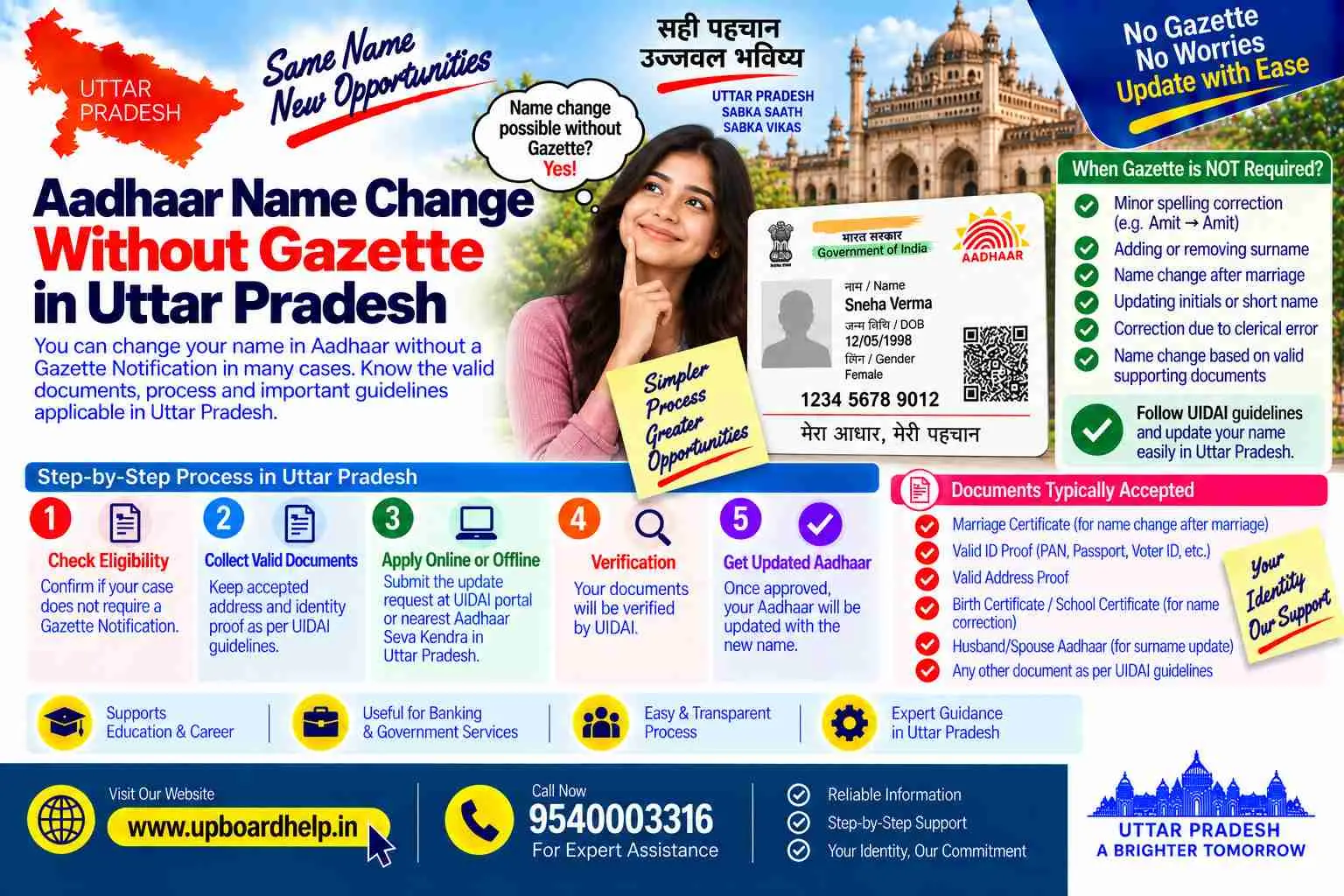
Document to Situation at a Glance
| Married surname | Registered marriage certificate |
| Reverting after divorce | Divorce decree, with the maiden name evidence |
| Adoption | Adoption order or deed |
| Misspelling | Any accepted document carrying the correct version |
| Expanded initial | Birth certificate or school record showing the full name |
| Court-ordered change | The order itself |
| Transliteration variant | A document with the spelling you want, ideally with the Devanagari record |
| A wholly new name | Nothing covers this; gazette |
Key Takeaways
- A gazette answers the question of why a name changed, so it is unnecessary wherever an event or an existing record already answers it.
- The document must be on UIDAI's accepted list and must itself show the version you are asking for.
- Life events carry particular weight because they explain the change and identify you at the same time.
- Avoiding a gazette does not avoid the update allowance, which is two name changes for life either way.
- Where nothing explains the change, publication is not a formality to dodge but the only thing that will satisfy the counter.
What Each Document Proves: Quick Facts
| Marriage certificate | Both names plus the event linking them |
| Divorce decree | The dissolution, and often the maiden name |
| Adoption order | The change of family, and the resulting name |
| Passport | A heavily verified version of your name |
| Board marksheet | The name recorded at school, often the oldest |
| Birth certificate | The anchor, where it exists and is correct |
| Court order | Whatever it records, with judicial weight |
| Gazette notification | A declared change, published, when nothing else explains it |
Table of Contents
- The question a gazette answers
- Life events that explain themselves
- Existing records that carry the answer
- When nothing covers it
- Avoiding a gazette does not avoid the limit
- Claims to be careful about
- Central Gazette name change: step by step
- Areas we serve
- Related guides
- Why choose our office
- FAQs
The Question a Gazette Answers
Framed that way, the whole subject becomes navigable. You are not looking for a way around a requirement; you are looking for the document that already contains your answer. And the reason life events are so powerful here is that they do two jobs at once: they explain the change and they identify the person, which is exactly what an identity counter needs before it edits a record.
Life Events That Explain Themselves
| Event | Document | What it covers, and what it does not |
|---|---|---|
| Marriage | Registered marriage certificate | Covers the surname. Does not cover a changed given name, because marriage explains only one half; see our Aadhaar after marriage page |
| Divorce | Decree, with proof of the maiden name | Covers reverting to the name you held before. Does not cover adopting a third name, per our divorce guide |
| Adoption | Adoption order or registered deed | Covers the change of family name that follows the adoption |
| A court proceeding | The order itself | Covers whatever the order records, with judicial weight behind it |
Two practical notes that decide these cases more often than the law does. First, the event document must be registered or issued, not merely have happened: an unregistered marriage produces no certificate and therefore explains nothing at a counter. Second, the document should carry both names where possible, because a paper showing only the new name proves the event but not the link to your existing record.
Existing Records That Carry the Answer
Where no event caused the change, because the change is really a correction, the answer lies in a record that was always right.
- Passport, among the strongest, because it is itself issued after substantial verification.
- PAN card, where it carries the correct version rather than repeating the error.
- Board marksheet or school certificate, often the oldest record of your name and therefore persuasive.
- Birth certificate, the anchor where it exists and is correct, and the document our correction versus change page tests first.
- Other listed government-issued identity documents, subject to UIDAI's current accepted list.
That test catches the commonest failure, which is carrying whichever document is nearest rather than the one that helps. Where a misspelling propagated years ago, most of your papers will confirm it, and the useful one is usually the oldest, as our Aadhaar spelling page explains in detail.
When Nothing Covers It
Three situations genuinely have no document behind them, and in each the honest advice is to publish rather than to keep looking.
- Adopting a wholly new name. A different given name, a surname unrelated to either family, a name chosen for personal or religious reasons. Nothing you hold says it, and no event caused it.
- Dropping a caste surname. A deliberate choice rather than an error, so no existing record shows the shortened version. Our surname guide covers the wider case.
- A change after the update limit is exhausted. Here the requirement comes from the exception route rather than from the nature of your change, and even a misspelling needs publication, as our limit page sets out.
In these cases a gazette is not an obstacle placed in your path; it is the mechanism that makes the change possible at all. Trying to route around it with an affidavit alone wastes a trip, because an affidavit is your own statement while a notification is a published government record, and a counter can rely on the second in a way it cannot rely on the first.
Avoiding a Gazette Does Not Avoid the Limit
A misunderstanding worth removing, because it changes how carefully people treat the easy route. Producing a marriage certificate instead of a gazette saves you Rs 1,100 and about two months. It does not save you an update.
So the discipline from our limit page applies in full even on the easy route: settle the complete final name, check every field rather than the one bothering you, and make one visit do all of it. People are markedly less careful about this when no gazette is involved, precisely because the step feels cheap, and that is how allowances get spent at twenty-eight.
Claims to Be Careful About
- "Gazette is compulsory for every name change." It is not. Where a marriage certificate, decree, adoption order or correct existing document explains the change, publication adds nothing.
- "An affidavit alone is enough at the Aadhaar counter." Generally not. An affidavit is your own sworn statement, and a name update needs a document from the accepted list.
- "We can get it done without any document." Nobody can. The counter is following a document rule, and an agent claiming otherwise is charging for something that does not exist.
- "You can do the whole thing online." Name updates are directed to a Seva Kendra in person because biometric verification is involved.
- "Publish now, it will be useful later anyway." Sometimes true if several records disagree, and wasteful if only one does. Decide on your actual situation rather than on a general principle.
The polite question that settles most of these at a counter is on our page about when a gazette is genuinely needed: ask what would be required if you did not have one. A real requirement produces an answer; a habit produces a repetition.
Central Gazette Name Change: Step by Step
Our core service: for the cases where nothing else explains the change, this is the filing our office runs from Lucknow every week. Where a document already covers you, we will tell you that instead.
Swear the affidavit
Notarised on stamp paper with the old name, the new name, your address and the reason, signed in the notary's presence in your own district.
Publish two newspaper advertisements
One Hindi daily of your district (Dainik Jagran, Amar Ujala or Hindustan) and one English paper, booked the same day, with complete original pages kept flat.
Type the proforma and prepare the CD
Two typed copies with two witnesses giving their signature, full name and address, and the CD carrying the declaration as typed Word text, opened on another computer to verify.
Pay Rs 1,100 on BharatKosh
Before dispatch, with the function head, PAO and DDO confirmed on the confirmation screen and the receipt printed for the envelope.
Courier the file to Civil Lines
Tracked dispatch to the Department of Publication, Delhi 110054, with your phone number and email on the covering letter.
Download and take it to the Kendra
Publication in 25 to 45 days, free download, three prints, and the notification carried with an identity document in the old name.
Writing the Reason When There Is No Event
A drafting point specific to this page's audience. Applicants whose change follows a marriage or a decree have an obvious reason to state. Those adopting a new name often stall on the affidavit because they are not sure what to write, and then write too much.
Whatever you choose, state it identically in all three places: the affidavit, both newspaper advertisements and the proforma. A reason worded three different ways is a discrepancy across the file, and the Department reads the file as a set. Our proforma guide shows exactly where the line sits.
Gazette Fees, Time and the File
| Document route | No gazette fee at all |
| Aadhaar update fee | Nominal and revised periodically; confirm at the Kendra |
| Affidavit | Rs 100 to 500 including stamp paper and notary |
| Adult gazette fee | Rs 1,100 on BharatKosh |
| Minor, through a guardian | Rs 1,700 |
| Newspaper advertisements | A few hundred rupees per paper, edition-dependent |
| Publication window | 25 to 45 days after the Department receives the file |
The Department's checklist in one line: covering letter with phone and email, affidavit (notarised), newspapers (both, original, whole pages), proforma (typed, two copies, applicant plus two witnesses), CD with signed declaration, photo ID, address proof, photographs, BharatKosh receipt.
Before You Apply: Check These
- Identify what your situation actually is, an event or a correction, before looking for documents.
- Check that your chosen document shows the exact version you want, not merely that it exists.
- Remember the update count applies on the easy route too, so settle the whole name first.
- If nothing explains the change, publish rather than continuing to look for a shortcut.
After the Gazette: What Updates Next
Whichever route you took, the chain afterwards is the same: Aadhaar first, then PAN so linking holds, then bank and employer, then the passport, the Tehsil certificate family, education records through their own processes, and finally insurance folios and property. Keep the document that carried your case, certificate, decree, order or notification, filed with the old and new records permanently, because the connection is what a later verifier will ask about.
What Other Websites Get Wrong
- Wrong: a gazette is compulsory for any Aadhaar name change. Right: it is the fallback where nothing else explains the change.
- Wrong: an affidavit can replace the document. Right: an affidavit is your own statement; the counter needs an accepted document.
- Wrong: any identity document will do. Right: it must show the exact version you are requesting.
- Wrong: avoiding a gazette avoids the update limit. Right: the count is the same whichever proof you produce.
- Wrong: keep searching for a workaround when nothing covers your case. Right: publication is what makes that change possible at all.
Areas We Serve in Uttar Pradesh
UIDAI's document rules are national, so what counts as sufficient proof does not change by district. What changes is which registry issued your event document. We advise across all 75 districts, most often these:
| Purvanchal and eastern UP | Varanasi, Prayagraj, Gorakhpur, Azamgarh, Jaunpur, Ballia, Deoria, Mirzapur, Basti, Ghazipur, Mau, Sonbhadra |
| Western UP and NCR | Noida, Greater Noida, Ghaziabad, Meerut, Agra, Aligarh, Mathura, Bulandshahr, Muzaffarnagar, Saharanpur, Hapur, Firozabad |
| Rohilkhand and Bundelkhand | Bareilly, Moradabad, Rampur, Shahjahanpur, Budaun, Pilibhit, Bijnor, Amroha, Jhansi, Banda, Mahoba, Chitrakoot |
| Awadh and central UP | Lucknow, Kanpur, Unnao, Raebareli, Sitapur, Hardoi, Barabanki, Lakhimpur Kheri, Sultanpur, Ayodhya, Amethi, Bahraich |
Marriage and divorce documents are issued in the district where the event was registered rather than where you live now, which is worth remembering when a certificate has to be retrieved before a Kendra visit. Our chamber is at Chamber No. 19, Sadar Tehsil, Sector 5, Gomti Nagar Vistar, Lucknow 226010, with the city guide on our Lucknow page. Call 9540003316 or WhatsApp 9540005002 from any district.
Related Guides on This Site
Every guide here is part of one connected map, so whichever counter your case lands at next, the page for it already exists:
- Aadhaar name update: the pillar covering the whole process.
- Aadhaar after marriage: the commonest document route.
- Aadhaar spelling correction: finding the record that was always right.
- the two-update limit: which applies on every route.
- correction versus change: identifying what your situation is.
- when a gazette is genuinely needed: and the question to ask when told otherwise.
- name change after divorce: the decree route.
- surname change guide: including dropping a caste surname.
- the proforma format: where the reason line sits.
- the full cost breakdown: government fees and service fees, line by line.
- contact the office: Lucknow office, phone and WhatsApp.
- mismatch with other records: machine matched or human read, and the fix for each.
- the Seva Kendra visit: finding a centre, booking and the counter.
Why We Look for the Document First
Our most expensive service is the one this page most often talks people out of. That is deliberate: an office that sells a Rs 1,100 filing to somebody holding a marriage certificate is not saving them time, it is charging them for a step they did not need. Vipin Chauhan, B.Tech LL.B, has taken that view for five years.
- We identify the situation before the solution: an event, a correction or a genuinely new name, because each has a different answer.
- We check the document actually helps: that it shows the exact version, rather than merely existing.
- We apply the update discipline either way: the count is the same whether or not a gazette is involved.
- We publish when publishing is the answer: without pretending a shortcut exists where none does.
Associate office at Chamber No. 19, Sadar Tehsil, Gomti Nagar Vistar, Lucknow, serving all 75 districts of Uttar Pradesh, Monday to Saturday, 10 AM to 6:30 PM. Call 9540003316 or WhatsApp 9540005002.
Tell Us What Is Changing
Uttar Pradesh Name Change
Associate Office: Chamber No. 19, Sadar Tehsil, Sector 5, Gomti Nagar Vistar, Lucknow, Uttar Pradesh 226010
Head Office: Metro Pillar 337, Hardev Nagar, Street 1, Shop No 1 (Shri Sham Documentation)
Call: 9540003316
WhatsApp: 9540005002
Email: info@uttarpradeshnamechange.com
Hours: Mon to Sat, 10 AM to 6:30 PM
Tell us what is changing and why, and list the documents you hold. In most cases one of them already explains it, and we will say so plainly.
Get Call and Name Change Format
Loading the enquiry form...
Aadhaar Without a Gazette: FAQs
Can I change my Aadhaar name without a gazette?
Usually yes. A gazette is needed only where nothing else explains the change. A marriage certificate, divorce decree, adoption order, court order or an existing document carrying the correct version each answers the question a counter is asking.
Which document covers a married surname?
A registered marriage certificate, which carries both names and the event linking them. Note that it explains the surname only; a changed given name usually needs a gazette.
What about reverting to my maiden name after divorce?
The divorce decree, together with evidence of the maiden name you are returning to. It does not cover adopting a third name unrelated to either.
Can I use an affidavit instead of a document?
Generally not at an Aadhaar counter. An affidavit is your own sworn statement, while a name update needs a document from UIDAI's accepted list. Affidavits work better where a person is weighing your file.
My passport has the correct spelling. Is that enough?
Usually yes, and it is among the strongest options because a passport is itself issued after substantial verification. The test is simply whether it shows the exact version you want recorded.
What if all my documents repeat the same error?
Then nothing proves the correct version and your case is a change rather than a correction. Look for the oldest record first, and if none exists, publication is the route.
Does avoiding a gazette save me an update?
No. Whichever proof you produce, the change spends one of your two lifetime name updates. The document changes the proof, not the count.
When is publication genuinely unavoidable?
Three cases: adopting a wholly new name, dropping a caste surname as a deliberate choice, and any change once your two updates are exhausted, where even a misspelling needs a notification.
Can an agent do it without any document?
No. The counter follows a document rule, so anybody promising a result without one is charging for something that does not exist.
What should I write as the reason on the affidavit?
One line, and no more: on account of marriage, as per family decision, or for personal reasons. Nobody is assessing whether your reason is good enough, and a long explanation only creates statements that can be questioned.
Does the unregistered marriage route work?
No, because without registration there is no certificate to produce. Register the marriage first, including late registration with a penalty, or use the gazette route.
Should I publish anyway, to be safe?
Only if several of your records disagree in different ways, in which case one notification saves repeated explanations. For a single mismatch covered by a document you hold, it is money spent on nothing.
Official Sources
- UIDAI's list of accepted proof of identity documents for a name update, which is revised from time to time.
- UIDAI's guidance directing name updates to an Aadhaar Seva Kendra, and its two-update lifetime allowance.
- Uttar Pradesh marriage registration through the Stamp and Registration Department portal.
- The Department of Publication's guidelines for change of name, which apply where no other document explains the change.
Facts on this page are checked against these sources and our own casework. The accepted document list changes periodically and should be confirmed before travelling; the principle that publication is a fallback is the stable core.
The Short Version
A gazette answers one question, why this record should now say something different, and it is needed only where nothing else answers it. Life events answer it well because they explain the change and identify you at once: a registered marriage certificate for a married surname, a divorce decree for reverting to a maiden name, an adoption order for a changed family name, a court order for whatever it records. Where the change is really a correction, the answer is an existing record that was always right, usually the oldest, and the test is whether it shows the exact version you want rather than merely existing. Three cases have no document behind them: a wholly new name, dropping a caste surname, and any change after your two lifetime updates are spent. And note that the easy route still costs an update, so settle the whole name before the visit either way.